Echolalia: Immediate, Delayed, and How It Looks in Adults
Reviewed by the LabReadAI medical team
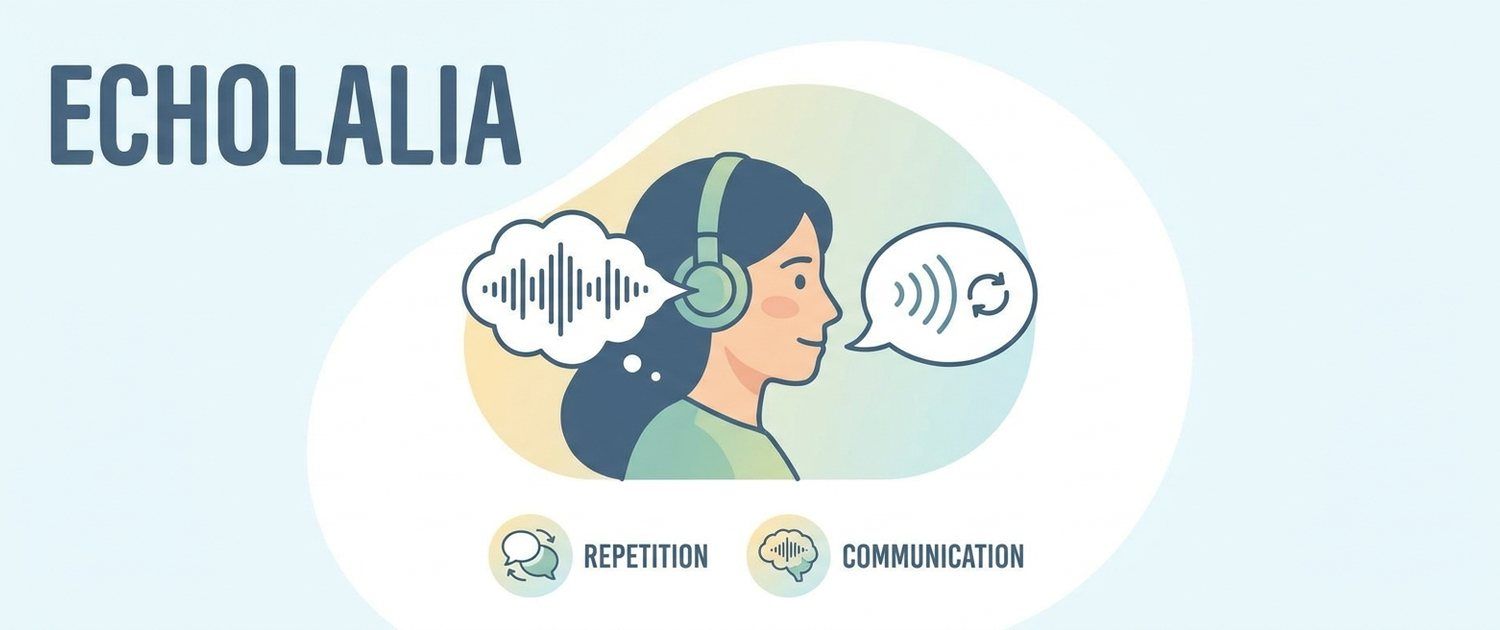
Echolalia is the repetition of something a person has heard: a single word, a phrase, a whole line with the intonation preserved. From outside it often reads as a glitch — the person did not answer, they repeated the question. But repetition usually does a job, and once you look at the job, the behaviour stops looking pointless.
What echolalia is
The term describes a form, not a cause. What gets repeated can be:
- someone else's line in full — "Do you want tea?" — "Do you want tea?";
- the tail of a phrase — only the last word of a long question comes back;
- intonation along with the words — the phrase arrives in the "voice" of whoever said it, down to a broadcaster's accent;
- your own phrase — that is palilalia, repetition of one's own words: a separate phenomenon with a similar shape.
A literature review on echolalia (Stiegler, 2015) states plainly that different disciplines — from behavioural approaches to linguistics — define and understand it differently, and that is precisely why the recommendations diverge, from "remove the behaviour" to "read it as communication". Worth knowing when you meet two opposite pieces of advice online: the contradiction is not in you, it is in the literature.
Immediate and delayed
Immediate echolalia comes within seconds of what was heard. Most often it buys time: while the phrase is repeated out loud, it gets processed. Sometimes it holds the question in memory while an answer is assembled. Sometimes it signals "I heard you, I am here", especially when no ready answer exists.
Delayed echolalia arrives later — an hour, a week, or twenty years later. A cartoon line, an advert, a teacher's phrase, a lyric. It can surface in a similar context (the phrase is tied to the situation where it was first heard), it can be a way of retrieving a state in which things were good, or it can simply taste right — its rhythm, its sound, the way it sits in the mouth.
A word on the popular "gestalt language processing" frame, in which delayed echolalia is described as a stage of acquiring language in whole chunks. A 2024 critical analysis (Hutchins) shows that the model has spread widely in practice while its evidence base and terminology raise serious questions. As a description of experience it resonates for many people; as a scientific theory it is contested. Both facts are worth holding at once.
What echolalia does
The functions most often described:
- Processing time. There is a gap between hearing and understanding; repetition fills it instead of leaving a silence the other person will read as being ignored.
- Regulating state. Repeating a familiar sound is soothing — mechanically close to stimming, with speech as the channel. In a noisy place a self-made sound also screens: it is predictable where someone else's is not — why someone else's can be physically unbearable is covered in the piece on sound intolerance.
- A ready-made. A prepared phrase fires faster than one assembled from scratch, especially once capacity is spent.
- Affirmation and refusal. Repeating the question can mean "yes" — a documented function, not an absence of an answer.
- Pleasure. Sometimes a phrase simply sounds good, and that is reason enough.
Reading the function always matters more than counting the frequency. The same repetition does different work in different situations.
How it looks in adults
In adults echolalia rarely appears as pure echo — it moves into more worn-in forms:
- scripting — lines prepared in advance for standard situations: how to answer "how are you", how to open a call, how to end a conversation, how to decline;
- quotes — lines from films, series, games and memes that make difficult things sayable;
- rehearsing aloud — running an upcoming conversation, sometimes in the exact words that will be used;
- repeating the other person's wording before answering — often read as a clarifying technique, though it is processing;
- a stuck phrase — a line that circles on its own, especially late in the day or after a heavy load.
One detail worth naming: scripting costs resource. You need many scripts, they wear out, and a new situation may have none that fits — at which point a conversation becomes disproportionately expensive. That is one reason recovery after intensive socialising takes so long; how it stacks with everything else is covered in the article on sensory overload.
Not only autism — and when to see a doctor
Echolalia is part of the autistic picture but not its property. It has no line of its own in the wording: repetitive speech sits inside the broader criterion about repetitive behaviour — how that wording is built is covered in the piece on the ASD diagnosis. Repetition of speech occurs in early language development, in tics and Tourette syndrome (echophenomena), in some forms of aphasia, in catatonia, in frontotemporal dementias, in delirium and after a range of neurological events.
Hence a practical rule that outweighs any theorising: if echolalia has appeared in an adult for the first time — it was not there before and now it is — that is a question for a neurologist, not for articles about neurodivergence. The same applies when the repetition arrives alongside new difficulties with speech, memory or orientation, or with a change in behaviour. If repetition of speech has been there since childhood and has only changed form, the picture is a different one, and it makes sense to look at it together with the rest.
Why suppressing it does not work
The logic of a ban sounds convincing: remove the visible behaviour and the person will look "like everyone". The trouble is that you remove the tool while the job it did stays exactly where it was. Research into adult experience on a neighbouring topic — stimming — found precisely this: participants described such actions as a way of coping with intense emotion and objected to approaches aimed at eliminating the behaviour (Kapp et al., 2019).
There is a second argument, about the observer's side. Crompton et al. (2020) compared information transfer along chains of eight people: in groups where everyone was autistic, information travelled as well as in groups where everyone was non-autistic; it was lost in the mixed groups, where participants also reported less rapport. The misunderstanding runs both ways rather than being one side's shortfall. Echolalia is exactly that case: from outside it reads as no answer, from inside it is the answer.
What helps when it gets in the way
It rarely gets in the way by itself — it gets in the way in specific places: a meeting, a call, an interview, a conversation with a stranger. What works:
- A legal pause. A prepared formula — "give me a second to word this" — legitimises the very gap the repetition exists to fill.
- A written channel. Wherever answering in text is possible, the problem disappears entirely; in work correspondence that is usually arrangeable.
- Repetition as a technique. "Let me check I've understood: …" is the same processing in a form the other person reads as attentiveness.
- A quiet place to script. Running a call out loud beforehand is cheap and removes a lot.
- Load relief around conversations. Echolalia intensifies on an empty tank, so a schedule fixes it more often than willpower does.
- Explaining instead of masking — where that is safe. A short "I sometimes repeat what was said while I process it" removes more than years of control.
If the picture is wider than one repetition and reaches back to childhood — communication needs decoding, changes are costly, the environment hits your senses — it makes sense to look at the whole of it: the autism test for adults brings those lines into one place, and the general frame is in the article on the signs of autism. A test neither makes a diagnosis nor rules one out.
When it is not autism
Repetition of speech and getting stuck on phrases happen for other reasons too.
- The aftermath of hard events and traumatic experience. Intrusive replaying of phrases and internal rehearsal of dialogues is a common part of it.
- Social anxiety. Scripts and rehearsals are used here as well, but the engine is different: not processing but fear of judgement.
- Personality traits. A love of quotes and precise wording means nothing on its own.
- ADHD. Losing the thread mid-sentence, asking again, repeating a question to hold it in mind — a familiar pattern here too.
- Long-running exhaustion and depression. At the bottom of the tank speech thins out and stock formulas displace live ones.
Separately, the bodily side. A shifted TSH, lack of vitamin B12 and iron, and chronic sleep loss slow speech and processing, produce fog and word-finding difficulty. What to look at is in the piece on what steals attention and in the guide to blood work in burnout; results you already have, the service will help you read. The boundary is firm: the body explains fatigue and slowing, but not why communication and sensory processing have been built this way since childhood.
This article is informational and does not diagnose. It does not claim that you are autistic, nor that you are not: that is determined by a psychiatrist in person. Echolalia appearing for the first time in an adult is a reason for an in-person medical assessment.
For informational purposes only
This article is for informational purposes only and does not constitute medical advice, diagnosis, or treatment. Please consult a healthcare professional for medical guidance.