Stimming: What It Is For and Why Suppression Costs Adults
Reviewed by the LabReadAI medical team
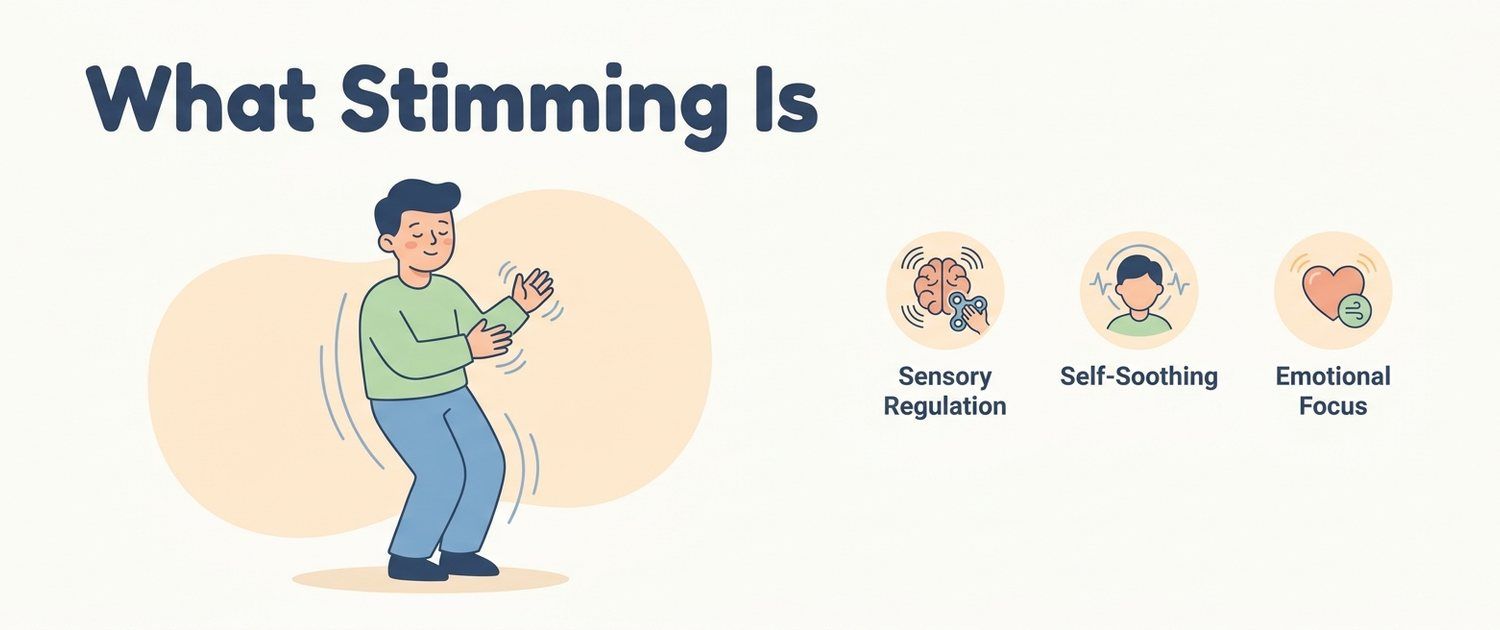
Stimming is short for self-stimulation: repetitive movements and actions a person uses to regulate their state. Rocking, pacing in circles, spinning a ring or a pen, snapping fingers, tapping a foot, repeating a sound or a line, twirling hair, clenching and unclenching a fist. Diagnostic descriptions call this "stereotyped or repetitive motor movements" — one item of the second line in the wording of an ASD diagnosis; the autistic community reclaimed the word in a different sense — as the name of a tool rather than of a trait.
What stimming is for
The easiest way to understand stimming is through the job it does. There are usually several jobs:
- Discharging tension. When more signals arrive than fit, a rhythmic movement provides predictable, controllable input to gather around.
- Holding attention. A monotonous action with the hands often does not interfere with listening but supports it: it occupies the channel that would otherwise go into distraction.
- Expressing strong feeling. Joy gets stimmed too — fast hand movement in delight is no less natural than rocking in anxiety.
- Coming back to yourself. After noise and people, repeating a familiar action is a way of landing back in your own body.
- Pleasure. Sometimes the movement simply feels good, and that is reason enough.
Kapp et al. (2019), built from interviews and focus groups with 32 autistic adults, describes stimming exactly this way: as a self-regulatory mechanism that helps with intense emotions and thoughts — and records that participants objected to approaches whose aim is to eliminate the behaviour. The second theme in the same study is a lack of social acceptance, which participants said understanding can dissolve.
And everyone stims. Non-autistic people click pens, jiggle a leg, twirl hair, walk around the room on a call — the difference is not in having the mechanism but in how heavily it is relied on and how visible its forms are.
Why autistic adults hide their stims
The reason is usually external, not internal: a visible movement draws looks, comments and questions, and in many settings a judgement about professionalism as well. So an adult learns to swap the visible for the invisible: muscle tension under the desk instead of rocking, fingers squeezed inside a pocket instead of hand movement, stillness instead of pacing — at a cost no one sees.
This is a special case of masking. The qualitative study by Hull et al. (2017) with 92 autistic adults described it as a three-stage process: motivations (fitting in, keeping connections), the techniques themselves (masking and compensation), and consequences — exhaustion and threats to self-perception. The price of invisibility is charged later, and not where it shows.
The same happens to the regulator. The mechanism does not go anywhere — access to it disappears at precisely the moment it is needed most: in a meeting, on public transport, in conversation with a stranger. After that, tension either builds toward a breakdown (see the article on sensory overload) or gets spent from reserves that will be missing in the evening.
A study of workplace experience (Sagar et al., 2024) — interviews and a focus group with 20 autistic people employed in predominantly neurotypical organisations — identified three themes: stimming as a beneficial coping mechanism, the repercussions of stim suppression, and stigma. Participants described the repercussions of suppression as worse wellbeing, increased stress and reduced productivity. The logic here is not about comfort but about arithmetic: suppression saves nothing, it relocates the cost.
When a repetitive movement really does need attention
Exactly one criterion: when it causes injury. Head banging, biting, scratching to the point of bleeding, damage to skin or teeth is a situation that needs help — but the task is framed differently from "training it away". The person still needs regulation; removing it with nothing offered in return takes away the tool and leaves the load.
What is done instead: work out what feedback the injurious action delivers (strong pressure? pain as an anchor? deep input to the joints?) and find a safe channel with the same quality of input, while reducing the load the whole thing arises under. That is a conversation with a specialist familiar with the topic, not a willpower project.
Everything else — rocking, spinning, tapping, repeating sounds — does not need correcting. It needs room.
Finding workable substitutes
The point of a substitute is not for the stim to vanish but for it to be available in any environment. It helps to match by channel:
- Movement — walking during calls, rocking in a chair, a short step into the corridor, stairs instead of the lift between meetings.
- Hands — a ring, beads, a silicone band, a paperclip, a quiet fidget object, a pen that does not click.
- Pressure — a weighted blanket at home, snug clothing, a backpack on the lap, interlocked fingers.
- Sound — headphones with a steady background when repeating aloud is impossible; for the speech-based form of repetition see the article on echolalia. When a background floor does not help because the environment's own sound is unbearable, the mechanisms are worth telling apart: that is covered in the article on sound intolerance.
- Mouth — gum, water, food with pronounced texture.
Two practical rules. First, choose the substitute in advance, not at the moment things are already bad. Second, do not take your main stim away from yourself at home — an environment where you do not have to hide relieves more than any set of gadgets.
And separately, about explaining. A short line to a colleague ("it helps me think") usually closes the question faster than years of control. The misunderstanding runs both ways here: to an observer the movement looks unmotivated because they cannot see the load it is relieving.
What to do with this next
Stimming on its own proves nothing: it exists in people who are not autistic, and one repetitive gesture does not make a picture. Looking wider makes sense when it is part of a stable whole reaching back to childhood: communication needs decoding and costs a long recovery, changes of plan are expensive, the environment hits your senses. In that case it is reasonable to gather the lines together — for example through the autism test for adults; the general frame is in the article on the signs of autism. Neither a test nor an article makes a diagnosis: a psychiatrist does that in person.
If, alongside the need to hide stims, long-running exhaustion has arrived and skills that used to be available are disappearing, that is a separate storyline: autistic burnout.
When it is not autism
Repetitive movements happen for various reasons, and not all of them concern neurodivergence.
- The aftermath of hard events and traumatic experience. Rocking and self-soothing movements are a common way of handling high background tension.
- Social anxiety. Spinning an object and small hand movements appear here too, but the engine differs — fear of judgement rather than regulation of sensory flow.
- Personality traits and temperament. Restlessness, needing to occupy the hands, walking while thinking are ordinary features on their own.
- ADHD. Motor restlessness and "keeping hands busy in order to listen" is a typical picture — and ADHD frequently co-occurs with autism.
- Tics. What distinguishes them is not intention but sensation: a tic usually comes with a premonitory urge and is experienced as involuntary. Repetitive movements of that kind are a question for a neurologist, especially if they started recently.
- Long-running exhaustion and depression. At the bottom of the tank both the need for self-soothing and the visibility of the movements go up.
Separately, the bodily side. Iron deficiency and low ferritin are linked to motor restlessness at rest; a shifted TSH and lack of vitamin B12 produce tremor, restlessness and difficulty sitting still. What to look at is in the piece on what steals attention and in the guide to blood work in burnout; results you already have, the service will help you read. The boundary is the same: the body explains restlessness and fatigue, but not why communication and sensory processing have been built this way since childhood.
This article is informational and does not diagnose. It does not claim that you are autistic, nor that you are not: that is determined by a psychiatrist in person.
For informational purposes only
This article is for informational purposes only and does not constitute medical advice, diagnosis, or treatment. Please consult a healthcare professional for medical guidance.