Autism and ADHD Together: How to Tell One Line From the Other
Reviewed by the LabReadAI medical team
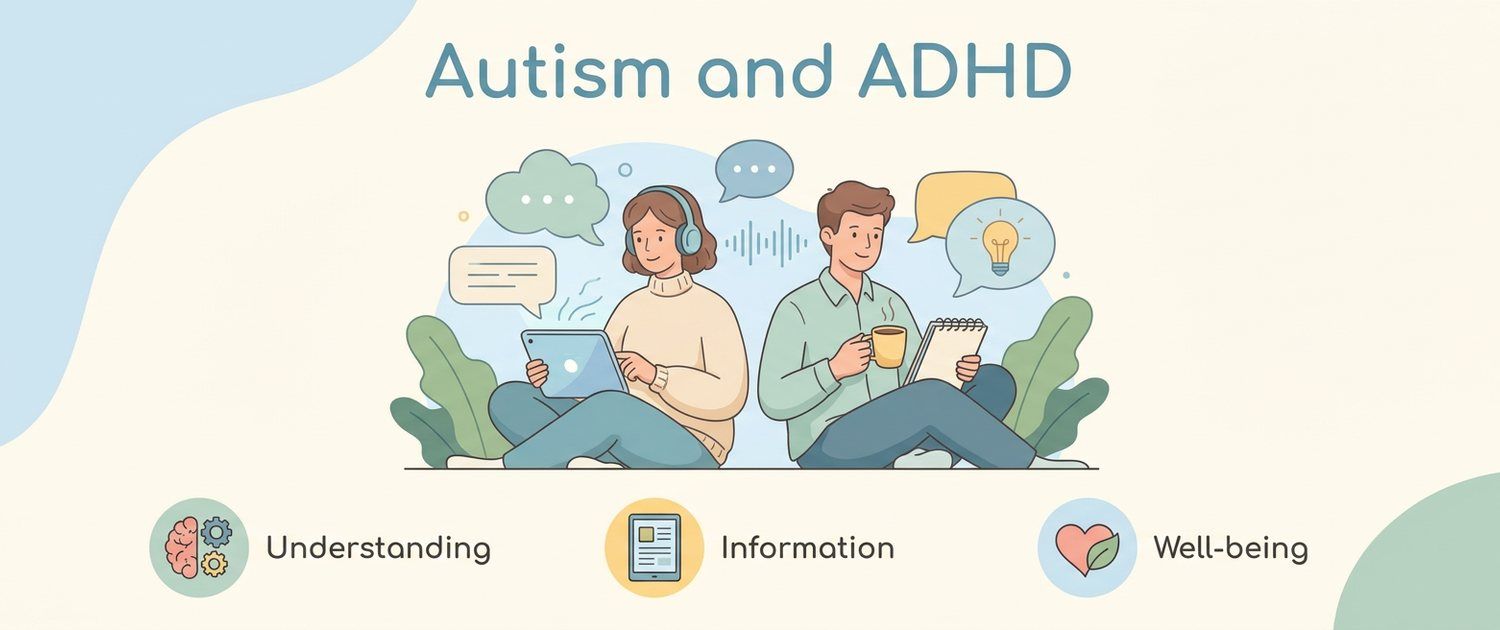
"Autism or ADHD" gets asked as a choice between two options, and the answer often dissolves the question: both. An autistic profile and ADHD turn up together in the same person markedly more often than chance would predict, and the review by Hours and colleagues describes the combination as a clinical reality of its own rather than a diagnostician's mistake. Online it has taken root under the shorthand AuDHD. Along with the shorthand came the habit of spotting both lines in public figures — who among them spoke about themselves and who was labelled at a distance is unpacked in the article on famous autistic people.
Why autism and ADHD were long forbidden together
Until 2013 a formal rule was in force: if autism spectrum disorder was established, ADHD could not be added as a second diagnosis. That was a decision of the classification, not a conclusion from data. DSM-5 lifted the exclusion, the two diagnoses became officially possible together — and the combination quickly turned out to be common. The same 2013 revision also retired the separate term "Asperger's syndrome", folding everything into one spectrum: what became of that word, and why Russian paperwork still carries it, is covered in Asperger's syndrome in adults.
Evidence of kinship between the two lines existed well before the permission. Work by Rommelse and colleagues described a shared heritable component and overlapping cognitive features long before the rules were revised. The review by Antshel and Russo unpacks how that overlap kept diagnosis running on an either-or principle.
The practical consequence: an adult diagnosed with ADHD in adolescence may never have heard about the second line — simply because back then nobody was allowed to look for it.
Opposite motives
The most useful difference between the lines is not a list of features but what each of them demands.
The autistic line needs predictability. The same route, a known plan, the same breakfast, a familiar environment, minimal unexpected input. A change of plan is expensive not because of unwillingness but because the whole structure has to be rebuilt.
The ADHD line needs novelty. A change of stimulus, interest, urgency, movement. Sameness does not soothe it, it extinguishes it: attention leaves and the task becomes physically hard.
When both lines are in one person, the demands collide head-on. Hence the recognisable scenes:
- a system built in fine detail and dropped within a week — followed by guilt about "no discipline";
- needing quiet and predictability while finding routine unbearable;
- craving a spontaneous trip and panicking when it happens without a plan;
- deep immersion in an interest and an inability to start the same thing tomorrow.
From outside this looks like inconsistency or selective laziness. From inside it is two systems with different jobs running in one head.
How the pictures differ: sensory processing and conversation
Where you do need to tell them apart, the difference runs along several axes.
What happens in conversation. In ADHD the impulse breaks the exchange: interrupting, a slipping thought, a lost thread, answering before the question is finished — while the rules of interaction themselves are clear. In an autistic profile the difficulty is in the interface: hints do not decode, small talk has no obvious function, moving from topic to topic requires translation. The full lists are in signs of autism and signs of adult ADHD.
Sensory processing. Hyperreactivity to sound, light, fabrics and smells is a characteristic line of the autistic profile. ADHD also brings distraction by an outside stimulus, but that is about shifting attention rather than physical intolerance of the stimulus itself.
Attitude to sameness. A need for things to stay the same and distress at a changed plan do not belong to ADHD. This is the axis that tells the two lines apart most reliably.
How immersion works. Both can produce a state where time disappears. In ADHD it captures unpredictably and by interest; in an autistic profile it is more often a stable deep interest returned to over years.
What sits behind a collapse. In ADHD a flare is usually tied to frustration and impatience; in an autistic profile, to accumulated overload and a sudden change of plan. One more thing makes them hard to tell apart in the moment: if putting a name to your own state is hard in principle — the trait covered in the article on alexithymia — both flares feel equally sudden from inside.
The caveat without which the list is useless: none of these axes works alone, and the combination makes the picture mixed by definition. Telling them apart is a clinician's job at a face-to-face assessment — how that works is described in autism assessment in adults.
Why the two lines turned out to be neighbours
The co-occurrence is usually explained in one of three ways, and the literature discusses all three at once.
First, a shared heritable component. Work by Rommelse and colleagues shows that features of both lines cluster in the same families and that their genetic contributions partly overlap. That is the most direct explanation for why the two lines occur together more often than chance would predict.
Second, shared cognitive mechanisms. The same authors' review of cognitive and brain characteristics describes the areas where the two pictures overlap: holding a task in mind, inhibiting a ready answer, switching between rules, sense of time. Hence the practical similarity of complaints: missed deadlines, tasks abandoned halfway, a heavy start.
Third, an observer effect. While the classification forbade a dual diagnosis, the second line simply went undescribed, and the accumulated statistics reflected the rules rather than reality. The DSM-5 change in 2013 shifted not the nature of the phenomenon but what was permitted to be seen.
None of these explanations cancels the others, and none turns the combination into a separate third illness. There are two lines, each with its own demands — which is exactly why practical arrangements have to be chosen for both at once.
Why AuDHD hides itself
The two lines that make up AuDHD are good at concealing each other. The impulsivity and talkativeness of ADHD make a person "too sociable" for the stereotyped portrait of autism, so the autistic line is never looked for. Conversely, the rituals and systems built by the autistic line compensate for organisational difficulty so well that ADHD does not look like a problem — for as long as those systems hold. While both compensations hold, everything looks fine from outside and the person receives an assessment instead of support: why a "mild form" misleads is covered separately.
Hence the typical scenario: one is found first, help produces partial results, and the remainder is put down to personality. In women this is stronger still — on why both lines are found later in them, see autism in women and ADHD in women.
What it changes in practice
Knowing there are two lines changes not the label but the shape of the day.
- A predictable frame with changeable filling. The same time, place and starting ritual — different tasks inside. That covers both needs at once instead of choosing which matters more.
- The sensory base, separate from motivation. Headphones, light, seamless clothing are not comfort but the condition under which the second line can work at all.
- External structure instead of willpower. Timers, someone else's presence, short stretches — for the ADHD line; warning about changes and a written agenda — for the autistic one.
- Recovery counts as a resource. With the combination a day costs more than either line alone, and planning without slack is the most common mistake.
- Co-occurring conditions go to a doctor. Anxiety, low mood and disrupted sleep travel alongside and respond to help — unlike the lines themselves, which there is no need and no way to cure.
One frequent question is worth removing separately: which line to "treat first". The lines themselves need no treatment — neither is an illness and neither has a target for a cure; more on that in can autism be cured. What gets addressed first is whatever gets in the way most right now: if that is anxiety and disrupted sleep, start there with a doctor; if it is overload at work, start with the environment. The order is set not by the diagnosis but by where the day currently costs most.
If you want your observations laid out along the lines before speaking to a specialist, there are two structured entry points: the adult autism test and the adult ADHD test. Neither diagnoses — they gather material to bring into the room. The general frame is in what ADHD is and the ASD diagnosis.
When it is not autism
Part of the picture may be explained otherwise, and that is worth holding in mind before any conclusion.
- Aftermath of hard events and traumatic experience: wariness, avoidance and difficulty concentrating appeared after something rather than always being there.
- Social anxiety: the rules of interaction are clear; being judged is what frightens.
- Personality traits: being introverted and needing solitude say nothing on their own.
- ADHD on its own: inattention and impulse without a need for sameness and without sensory hyperreactivity.
- Long exhaustion and depressive states: both the scattered attention and the withdrawal are new here, not lifelong.
Bodily causes are separate. A shifted thyroid (TSH), low iron (low ferritin), low vitamin B12 and vitamin D, chronic sleep loss explain fatigue, brain fog and irritability — but not sensory sensitivity and communication difficulty present since childhood. What to look at is in the pieces on what steals attention and which tests make sense in burnout; results you already have, the service will help you read.
This article is informational and does not diagnose. Both conditions are established by a doctor in person.
For informational purposes only
This article is for informational purposes only and does not constitute medical advice, diagnosis, or treatment. Please consult a healthcare professional for medical guidance.