How to Lose Weight With Insulin Resistance: Food, Movement and Tests
Reviewed by the LabReadAI medical team
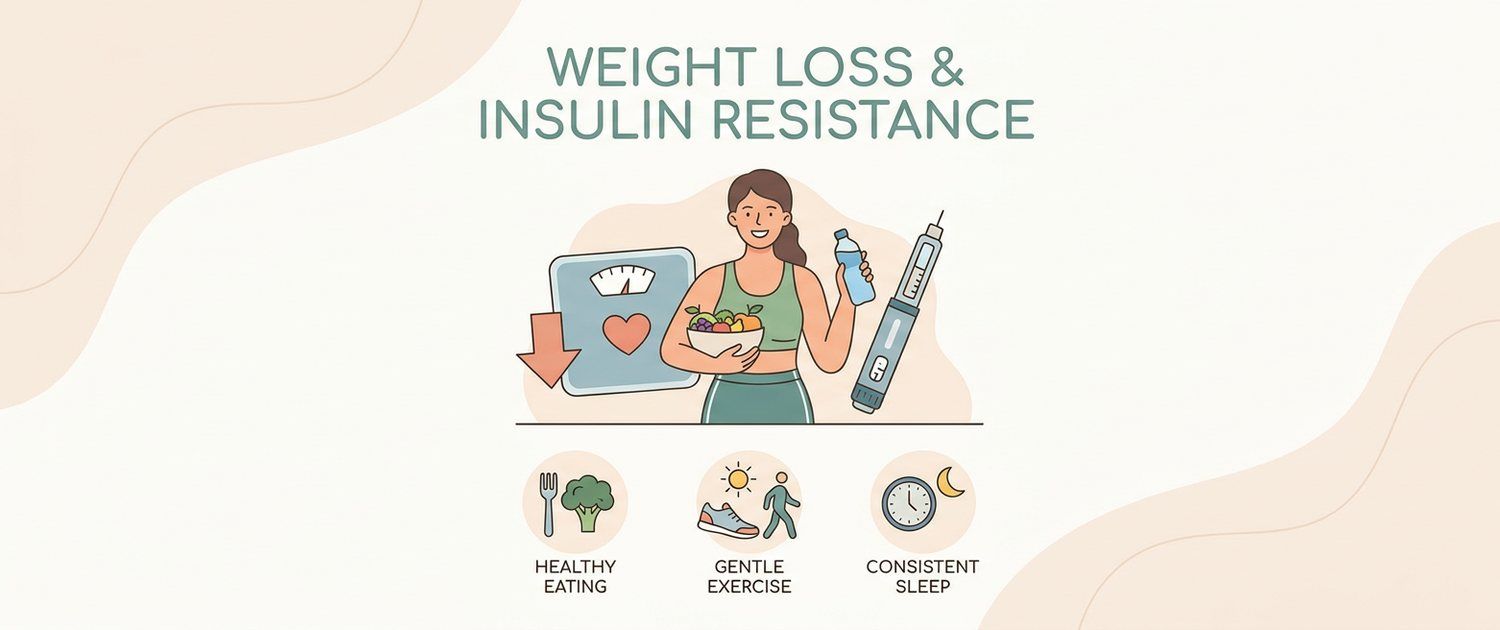
Losing weight with insulin resistance really is harder — but not because your metabolism is "broken for good". The reason is specific: high circulating insulin suppresses fat breakdown (lipolysis), so stored energy leaves fat cells less readily. What helps is not starvation or a "forbidden foods" list, but a calm shift of the plate toward fibre and protein instead of fast carbohydrates, regular strength and aerobic exercise, enough sleep, and — where needed — medication chosen by a doctor. Even a modest weight loss (5–7%) noticeably lowers insulin resistance and starts turning the cycle the other way.
This article is about the practice of losing weight when insulin resistance is already known. If you need the mechanism, causes and full work-up, that's in a separate article on insulin resistance: causes, symptoms and how to test. Here — what to do next.
Why Insulin Resistance Makes Weight Loss Harder
Insulin is not only the "key" that lets glucose into cells. It has a second role: insulin is the body's main storage signal. As long as it stays high in the blood, the body gets a "store, don't spend" command — it suppresses lipolysis, the breakdown of fat into fatty acids that can be burned. That is exactly why high insulin is well studied as an anti-lipolytic (fat-sparing) hormone.
In insulin resistance, cells respond poorly to insulin, so the pancreas produces it in surplus — chronic hyperinsulinaemia develops. The loop closes: high insulin → fat stays locked in storage and deposits more easily → more visceral fat accumulates → it drives insulin resistance even harder. This vicious cycle is covered in more detail in the metabolic syndrome article.
Two honest conclusions follow. First: with insulin resistance, weight comes off more slowly than in someone with normal insulin sensitivity — that is normal, not a sign that "nothing works". Second: the target is not merely a calorie deficit at any cost, but lowering background hyperinsulinaemia. Once insulin stops keeping fat "under lock", the same calorie deficit starts working noticeably better.
It also matters that subcutaneous fat on the hips and visceral fat around the organs behave differently: it is visceral fat that is metabolically active and sustains insulin resistance. That is why a shrinking waist is a more accurate marker of progress than the number on the scale.
There is a reassuring flip side to this mechanism. Hyperinsulinaemia and insulin resistance largely develop as the body's response to excess fat tissue and free fatty acids — meaning they are to a large extent an acquired, adaptive state, not a hard-wired defect. As visceral fat starts to shrink, background insulin falls too, and the lower the insulin, the more freely fat leaves storage. The same cycle that pushed weight up starts working in your favour. That is why the first kilograms are the hardest, and the process usually runs more smoothly afterwards.
How to Tell Whether You Have Insulin Resistance
Insulin resistance is painless for years, so it is spotted by indirect signs and confirmed with tests. Watch for:
- Fat concentrated at the abdomen — an "apple" shape, a growing waist despite relatively stable weight.
- Drowsiness and low energy after meals, especially carbohydrate-rich ones — glucose is high in the blood but enters cells poorly.
- Hard-to-control cravings for sugar and refined carbs — a consequence of swinging glucose levels.
- Dark, velvety skin folds on the neck, in the armpits or groin (acanthosis nigricans) — a visible marker of hyperinsulinaemia.
- Slow weight loss on a deficit that "should" be working.
Clinical signs aren't enough — tests are needed. The baseline panel for assessing insulin resistance is small:
| Test | Reference | What it shows |
|---|---|---|
| Fasting glucose | normal < 5.6 mmol/L; 5.6–6.9 = prediabetes | current sugar level |
| Fasting insulin | roughly up to ~10–12 µIU/mL | how "overloaded" the pancreas is |
| HOMA-IR | usually > 2.5–2.9 suggests IR | composite index of insulin resistance |
| Glycated haemoglobin (HbA1c) | normal < 5.7% | average sugar over 2–3 months |
HOMA-IR is calculated as (fasting glucose × fasting insulin) / 22.5; a handy breakdown with a calculator and thresholds is in the HOMA-IR index article. Glucose and insulin are drawn strictly fasting; HbA1c does not require fasting. If fasting sugar is already in the prediabetes range, that's a separate conversation — see prediabetes.
The thresholds in the table are approximate and depend on the lab and method; interpreting them in context — together with waist, blood pressure and lipids — is a doctor's job. Which tests are worth doing before starting weight loss is covered briefly in the general insulin resistance article.
Nutrition for Insulin Resistance: No "Banned List", No Fad Diets
First, the myths. There is no food that "cures" insulin resistance, and no rigidly forbidden list that guarantees weight loss. What works is not a ban but the composition of the plate: the fewer sharp glucose spikes, the smaller the insulin surge after eating — and the easier it is for fat to leave storage.
Three working principles, not a diet with gram counts:
- Fewer fast carbohydrates. Sugar, sweet drinks, white flour and confectionery produce the sharpest glucose and insulin rise. It's sensible to limit them — but "limit" doesn't mean "never": the goal is sustainable, not heroic.
- More fibre. Vegetables, legumes and whole grains slow glucose absorption and smooth the insulin response. Fibre is the most underrated tool in insulin resistance.
- Enough protein. Protein is satiating, helps preserve muscle on a deficit (and muscle is the main glucose consumer), and barely raises insulin the way fast carbs do.
| What helps | Myths that don't help |
|---|---|
| Vegetables, legumes, whole grains (fibre) | "Cut out all carbs forever" |
| Protein at every meal | "Eat only by the clock / hard fasting window as a goal in itself" |
| Unsaturated fats (fish, nuts, olive oil) | Detox juices, "fat-burning" foods and supplements |
| A sustainable moderate calorie deficit | Extreme mono-diets and fasting to the point of weakness |
| Fewer sweet drinks and added sugar | Expensive "sugar-free" products instead of whole food |
A word on the order and structure of a meal, not just its content. Carbohydrates are almost always gentler on insulin when they don't come "solo" but alongside fibre, protein and fat: a whole plate with vegetables, protein and a grain raises glucose more gradually than the same portion of carbs on its own. For the same reason it's wiser to leave something sweet for the end of a meal rather than eat it on an empty stomach. Attention to liquid calories helps too: sweet drinks and juices cause an insulin spike with almost no satiety — cutting them often matters more for weight than heroic restrictions on solid food.
On dietary format, honesty matters: in people with marked insulin resistance a lower-carbohydrate diet often produces more glucose and weight reduction than a high-carbohydrate one — but this is not a universal law or a licence to go extreme. The same studies show the reverse too: in people with preserved insulin sensitivity the advantage of a low-carb format disappears, and sometimes the opposite works better. The response is individual: what suits one person is not necessarily optimal for another, and the format is best chosen with a doctor or dietitian rather than copied from someone else. Don't take any specific "grams of carbs per day" from this article — that is set individually.
One more thing that removes needless anxiety: strict bans almost always lose to sustainable habits. A diet from which "nothing at all is allowed" lasts weeks, then breaks — and the weight rebounds along with your mood. A flexible version ("mostly this, occasionally that") tends to deliver more over months than a perfect diet you cannot keep up.
The Role of Movement: Strength Matters More Than You Think
Physical activity lowers insulin resistance partly regardless of whether weight has changed: a working muscle takes glucose from the blood via a "back-up" route that needs almost no insulin. So movement is not just a way to "burn calories" but a direct tool against hyperinsulinaemia.
- Strength training — the underrated half. More muscle mass means a bigger "reservoir" for glucose and higher insulin sensitivity at rest. Two or three sessions a week for major muscle groups give an effect that persists between workouts.
- Aerobic exercise — brisk walking, cycling, swimming. Guidelines suggest around 150 minutes of moderate activity per week, but it's sensible to start at the level you can actually keep up regularly.
- The combination of aerobic and strength work outperforms either alone in diabetes-prevention studies.
Another underrated lever is everyday activity and ordinary walking through the day. For someone with a lot of excess weight or joint problems, that — not gruelling workouts — is often the sustainable starting point. The point is regularity, not intensity to exhaustion.
A useful detail: a short walk after a meal is one of the simplest ways to blunt the post-meal glucose rise, and with it the insulin surge. Even 10–15 minutes of easy walking after your main meal helps noticeably, and it needs neither a gym nor kit. Part of exercise's effect on insulin sensitivity shows up before the scale even moves — so movement is worth starting right away, not waiting for a "result on the scale" as the reward.
Sleep and Stress: Cortisol Works Against You
Sleep loss and chronic stress are not "motivation trivia" but physiology. Sleep deprivation on its own lowers insulin sensitivity within a few nights and increases cravings for calorie-dense food. Chronic stress keeps cortisol elevated, and cortisol specifically promotes abdominal fat and works against weight loss.
A practical minimum that often matters more than yet another tweak to the diet:
- 7–9 hours of sleep and a fairly stable bedtime — the base without which food and training work worse.
- Stress offloading — a walk, breathing practices, any regular physical activity (which also lowers insulin resistance).
- Attention to sleep apnoea. Snoring with pauses in breathing often goes hand in hand with visceral obesity and insulin resistance and clearly hinders weight loss — a reason to discuss an assessment with a doctor.
If food and training are dialled in but weight stalls, before tightening the deficit, honestly check your sleep and stress. The brake is often hidden here.
When You Need a Doctor and What About Medication
Losing weight with insulin resistance is first and foremost about lifestyle, but not always only that. See a doctor (GP or endocrinologist) if:
- fasting glucose is consistently ≥ 6.1–7.0 mmol/L or HbA1c approaches the diabetic range;
- there are pronounced symptoms (intense thirst, frequent urination, sharp weight loss or gain);
- weight won't move despite honestly built food, movement and sleep over several months;
- insulin resistance coexists with high blood pressure, lipid disturbance or metabolic syndrome.
On medication — plainly and without illusions. Metformin and GLP-1 receptor agonists (semaglutide, liraglutide and others) are indeed used for glucose-metabolism disturbances and obesity and can improve insulin sensitivity and help with weight loss. But these are prescription drugs, and prescribing them is a doctor's responsibility: indications, doses, contraindications and monitoring are chosen individually. This article gives no doses or regimens and does not replace a consultation — self-prescribing such drugs is dangerous. An overview of one class is in the article on weight-loss drugs (Ozempic and analogues).
Separately, remember: weight loss and dietary change lower blood sugar on their own. How that works without medication is in how to lower blood sugar. And if excess weight has already crossed into clinical obesity, the obesity article is a useful read.
How to Track Progress
The scale is a poor lone judge: water, glycogen and the cycle cause 1–2 kg swings within a day. It's more reliable to watch a cluster of markers over time:
- Waist circumference — a direct marker of visceral fat; it often shrinks before the "nice" scale number does.
- How you feel after meals — the post-lunch drowsiness fades, energy steadies, sugar cravings weaken.
- Test trajectory — fasting insulin and glucose with a recalculated HOMA-IR after a few months show whether background hyperinsulinaemia is falling.
A realistic target is not "minus 10 kg in a month" but a steady 0.25–0.5 kg per week without weakness or bingeing. Slow and without "forever" bans is almost always more reliable than a fast result that rebounds.
It also helps to understand that a plateau is a normal part of the journey, not a failure. The body adapts to a new weight and routine, and a stall of a couple of weeks on an otherwise sound strategy usually resolves on its own, without tightening the deficit. Far more often the problem is not a "too gentle" diet but sleep loss, stress or unnoticed liquid calories. So when weight stalls, check the basics first — sleep, movement, drinks — and only then change something. And most importantly: insulin resistance is, in most cases, a condition that responds to lifestyle change. Slow progress is still progress, and it's heading the right way.
This article is for informational purposes only and does not replace a consultation. Diagnosis, a nutrition plan and any medication are the responsibility of an endocrinologist or general practitioner.
For informational purposes only
This article is for informational purposes only and does not constitute medical advice, diagnosis, or treatment. Please consult a healthcare professional for medical guidance.