Jealousy in Relationships: Where It Comes From and How to Stop
Reviewed by the LabReadAI medical team
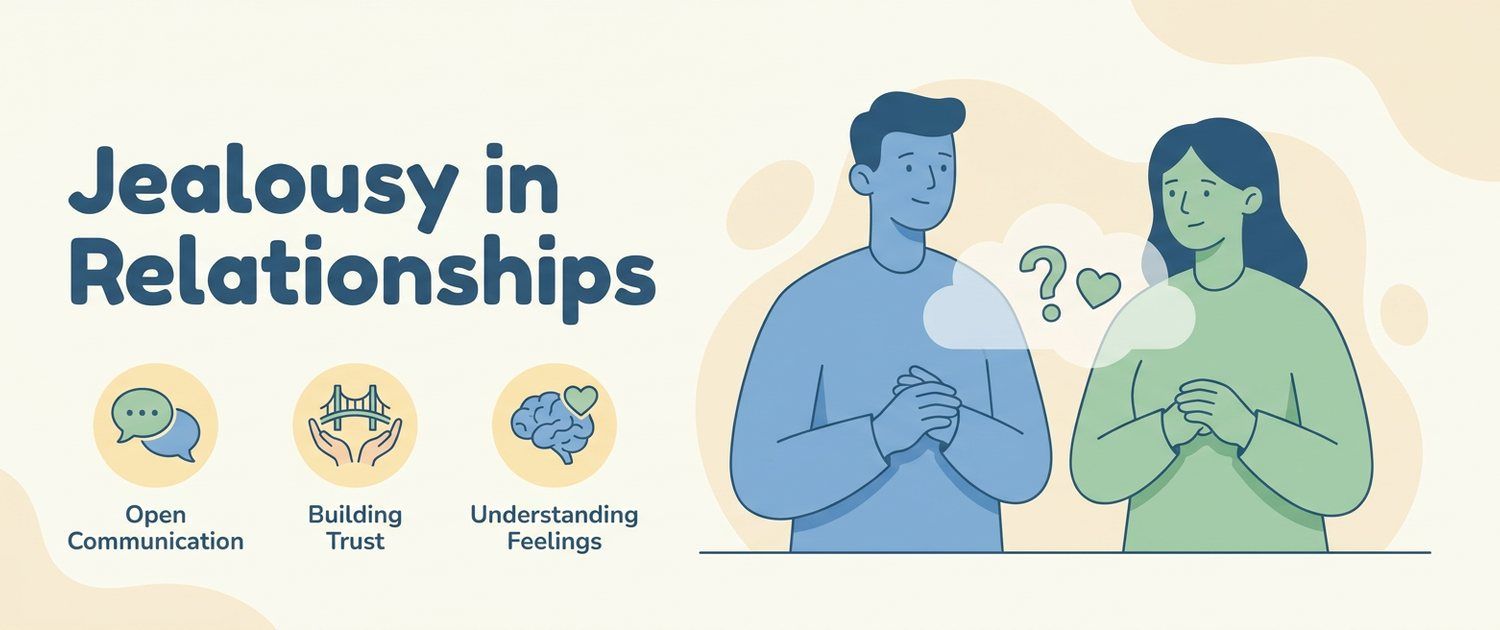
Is jealousy an emotion, a character trait or a symptom? None of the three. Jealousy is a reaction to a perceived threat to a significant bond, and that is what separates it from envy: you envy what you do not have and are jealous over what you fear losing. The reaction is triggered by a forecast rather than by facts, which is why arguing with evidence rarely helps — and why the forecast itself is what can be worked on.
Why am I jealous: the mechanics of the anxiety axis
Jealousy does not grow on its own. Research consistently links it to insecure attachment — above all to its anxiety dimension: the higher the anxiety, the lower the threshold at which an ordinary situation reads as a threat. The mechanics are the same as in the rest of that axis:
- Uncertainty appears: no reply, a late return, someone new in their circle.
- The attachment system reads it as a threat signal.
- A search for reassurance switches on: check, ask, look.
- Reassurance brings calm briefly — and teaches the system that calm is reachable only through checking.
That is why jealousy is not a separate illness: it is the behavioural outlet of the anxiety axis. The axis is covered in the anxious attachment style, and in its most pronounced form the same mechanism is described as emotional dependency. The overall map is in the guide to attachment styles.
Is jealousy a sign of love?
No, and this is arithmetic rather than moralising: the strength of jealousy reflects the anxiety axis, not the depth of feeling. Someone with low anxiety can be deeply attached with almost no jealousy; and the reverse holds too. A more useful question than "how much do I love" is "what exactly am I trying to prevent right now".
The second common myth is that jealousy mobilises a partner. In practice it does the opposite: it widens the distance for anyone whose avoidance axis is already high. How that cycle unfolds in a couple: attachment style compatibility.
Pathological jealousy and fits of jealousy
The line has to be drawn honestly. Ordinary jealousy is unpleasant but manageable: it can be noticed, named and not acted on. Pathological jealousy is when the conviction of betrayal is not corrected by any evidence, occupies most of the day and leads to surveillance, interrogations or control. Such a state can be linked to mood disorders, addictions and other causes, and it belongs to a doctor rather than to self-help. Fits of jealousy with loss of behavioural control fall into the same category.
A separate, non-negotiable line: if one person's jealousy turns into surveillance, isolation or threats, this is no longer about attachment. To assess what is happening to you around someone, the test "The person next to you" helps; and if you fear for your safety, you need real-world help.
Clinginess: the checks that do not help
"How do I stop being clingy" usually hides the same cycle of checks: re-reading conversations, seeing who is online, asking once more whether they are really not angry. The problem is not the quantity but the design: each check briefly removes anxiety and thereby confirms that without the check things would have been bad.
The working principle is not a ban but a delay. A ban raises anxiety and ends in a relapse; a twenty-minute delay lets the system live the anxiety through to the end and discover that it subsides on its own.
How to stop being jealous: what works
- Separate fact from forecast. "He did not reply for two hours" is a fact. "He is with someone" is a forecast. Written in two columns, they stop fusing.
- Postpone the check. Twenty minutes is the working unit; reduce the frequency rather than ban it.
- Ask directly instead of checking. "I'm anxious, tell me we're okay" costs less than an interrogation and does not damage contact.
- Discuss agreements, not suspicions. What counts as normal for both of you in contact with others is a conversation you can have; "prove that you love me" is not.
- Look at where it grows from. If jealousy is strongest with someone who runs hot and cold, that is about the reinforcement schedule rather than about them: see the emotionally unavailable partner. If anxiety and withdrawal alternate inside you, the closer region is fearful-avoidant.
- Check the general anxiety background. If you feel anxious outside relationships too, start with a clinical scale: the anxiety test.
To find which facet of the anxiety axis is loudest in you — fear of rejection, need for reassurance or vigilance for signs of cooling — take the attachment style test. We deliberately do not build a "jealousy test": measuring a consequence instead of a cause is pointless. And if the jealousy grew out of the two of you seeing the same relationship differently, that is visible only together — there is a compatibility test for two where both answer the same questions and the two pictures are compared.
What to do if your partner is the jealous one
Three things genuinely lower the heat, and one does not:
- Predictability. Not reporting in, but a simple "I'm at a meeting until eight" said in advance. The anxiety axis needs the absence of uncertainty, not restrictions on your movement.
- Respond to the feeling, not to the accusation. "You're anxious right now" moves a conversation further than "stop suspecting me".
- Clarity of boundaries. Your boundaries stay yours; they are discussed, not surrendered under pressure from someone's anxiety.
- Does not work — justifying yourself and proving things. Proof closes the episode and strengthens the cycle.
When it is not about attachment at all
A sharply increased anxiety background and being "on edge over nothing" can be amplified by the body: hyperthyroidism, low iron, B12 and vitamin D, excess caffeine, chronically high cortisol and disrupted sleep all lower the threshold at which alarm fires. The role of serotonin is often mentioned here, but measuring it in blood to judge mood is meaningless and we do not suggest it. If you already have results, our service can read them in plain language.
This article is for information only and does not replace a professional consultation. A fixed conviction of betrayal that no argument can shift needs in-person medical help.
For informational purposes only
This article is for informational purposes only and does not constitute medical advice, diagnosis, or treatment. Please consult a healthcare professional for medical guidance.