The Anxious Attachment Style: Signs and How to Live With It
Reviewed by the LabReadAI medical team
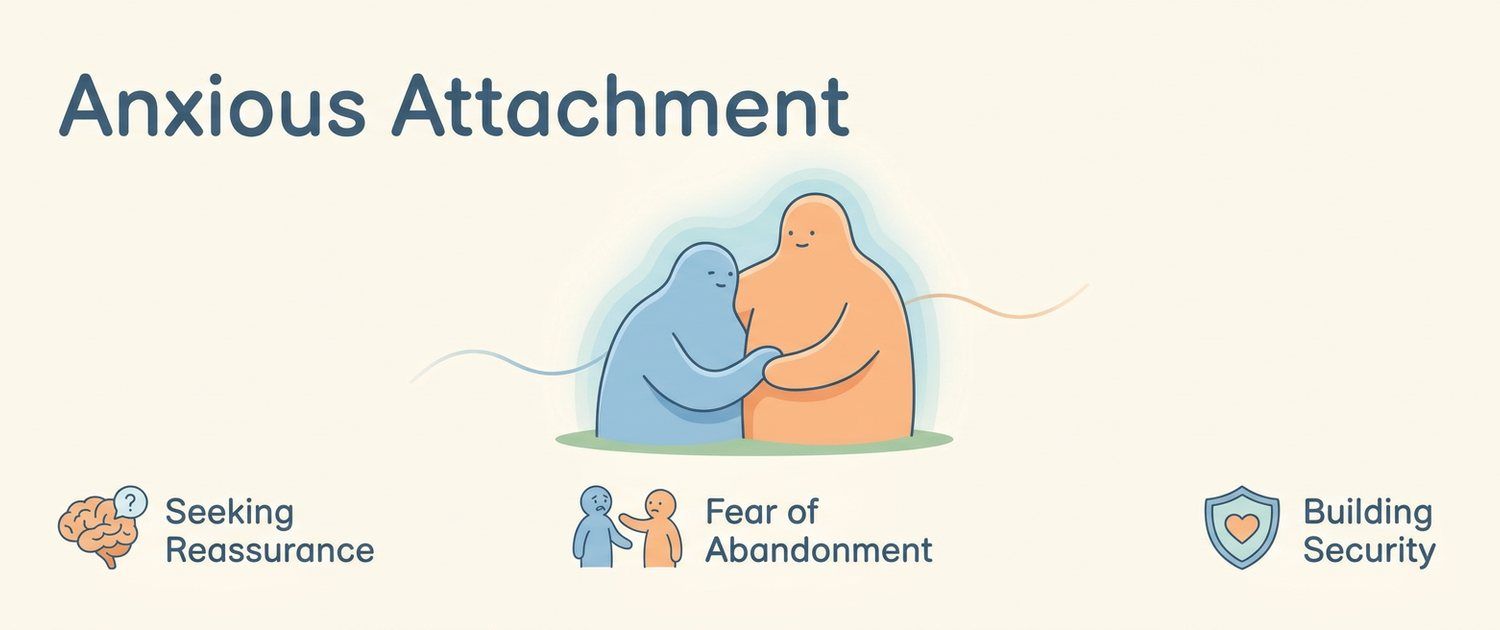
Anxious attachment is the region of the close-relationship map where the anxiety axis is high and avoidance is low. Closeness is needed and handled well; uncertainty is what hurts. A pause in messaging, a changed tone, a "let's talk later" — none of it passes as a neutral fact. Each reads as a signal that the bond is at risk and demands an immediate check.
What the anxious attachment style is
In the literature this region is called preoccupied, and its childhood predecessor is called anxious-ambivalent. The mechanism is described as a hyperactivating strategy: when the bond feels threatened, the attachment system does not calm down but amplifies the signal — seeking contact, reassurance, clarity. It is the mirror of avoidant deactivation, and both strategies are equally logical: one learned that asking is pointless, the other that asking has to be louder or it will not be heard. The overall map is in the guide to attachment styles.
Signs of anxious attachment
- Silence reads as a threat. Three hours without a reply and a whole storyline about something being wrong is already assembled.
- A regular "are we okay?" check is needed — and the relief it brings is short.
- Preoccupation with the relationship. Thoughts about it take up a visible part of the day and crowd out tasks.
- Vigilance for signs of cooling. The smallest changes in tone, reply speed and wording get noticed.
- Self-blame. "I ask for too much", "I ruined it" is the default explanation.
- Fear of rejection. Not a fear of solitude as such, but of being rejected by this particular person. It is regularly confused with the fear of intimacy, though that belongs to the opposite axis: there the threat is contact itself, here it is losing it.
A single item settles nothing. A type is the combination of two axis scores, so a correct result looks like a point with coordinates rather than a label.
Anxious attachment in relationships
From the outside it looks like "too much": too many messages, questions, needs for reassurance. From the inside it is an attempt to get the ground back. The key trap is that behaviour which relieves anxiety for five minutes — checking again, asking once more, calling — reinforces the mechanism: the system learns that calm is only reachable through contact.
Three storylines usually searched for separately grow from this axis:
- jealousy and compulsive checking — not a separate trait but a behavioural consequence of anxiety;
- emotional dependency — the everyday name for a strongly pronounced axis;
- a persistent pull towards people who keep their distance — the emotionally unavailable partner.
The classic couple configuration is anxious plus avoidant: one needs to be closer, the other needs air, and the same argument runs for years. See attachment style compatibility; the mirror axis is described in detail in the avoidant attachment style.
Anxious-ambivalent, preoccupied, anxious attachment — the same thing?
Practically yes, with one caveat. "Anxious-ambivalent" is a term from the childhood classification (the child both reaches for the mother and is angry at her on reunion). "Preoccupied" is the adult term from the four-category model. "Anxious attachment" is the colloquial version. All three point at one region of the map. But fearful-avoidant is something else: there both axes are high and the picture is fundamentally different — the reading is here.
What research says about the origin
The anxiety axis forms where responsiveness was unpredictable: sometimes there, sometimes not. Unpredictable reinforcement is the most durable way to lock in a behaviour, which is exactly why amplifying the signal becomes a strategy. On the roots, see Bowlby and Ainsworth's attachment theory. One more detail: the anxiety axis barely breaks into independent parts — its facets are strongly correlated and read as shades of a single theme, whereas avoidance splits into more independent scales.
Anxious attachment in men
Sex differences on this axis do exist in meta-analysis, but they are small: women score slightly higher on anxiety on average. The spread within each sex is far larger than the gap between them, so anxious attachment in men is ordinary; what mostly differs is how it looks from outside. Hyperactivation may show up not as "do you love me?" but as control, irritation and resentment — the mechanism is the same.
How to fix anxious attachment: what works
The good news is backed by data: in therapy research it is anxiety that falls most consistently, and longitudinal studies show it declining naturally with age and with dependable relationships. The directions that genuinely change the mechanism:
- Separate fact from interpretation. "No reply for two hours" is a fact. "He is tired of me" is a hypothesis. Written down separately, they stop fusing.
- Postpone the check rather than ban it. A total ban raises anxiety; a 20-minute delay teaches the system that calm is possible without contact.
- Ask directly instead of hinting. "I'm anxious, tell me we're okay" works better than a check staged through a fight.
- Look at facets, not at the label. In one person the fear of rejection is loud, in another it is self-blame, and that is different work.
- Separate relationship anxiety from an anxiety disorder. If anxiety persists outside relationships and gets in the way of living, start with a clinical scale: the anxiety test.
Where you land and which facet to start with is shown by the attachment style test, which scores all six facets of the anxiety axis separately. Where to move in the long run is described in the secure attachment style.
When it is not about attachment at all
If anxiety has become a background inside and outside relationships, check the body. Hyperthyroidism, low iron, B12 and vitamin D, excess caffeine and chronically high cortisol produce exactly the same picture: edginess, poor sleep, a sense of impending trouble. This does not replace the conversation about attachment, but it takes some load off it. If you already have results, our service can read them.
This article is for information only. Anxious attachment is not a diagnosis and not a disorder — it describes how you answer today.
For informational purposes only
This article is for informational purposes only and does not constitute medical advice, diagnosis, or treatment. Please consult a healthcare professional for medical guidance.