The Secure Attachment Style: Signs and How to Earn It
Reviewed by the LabReadAI medical team
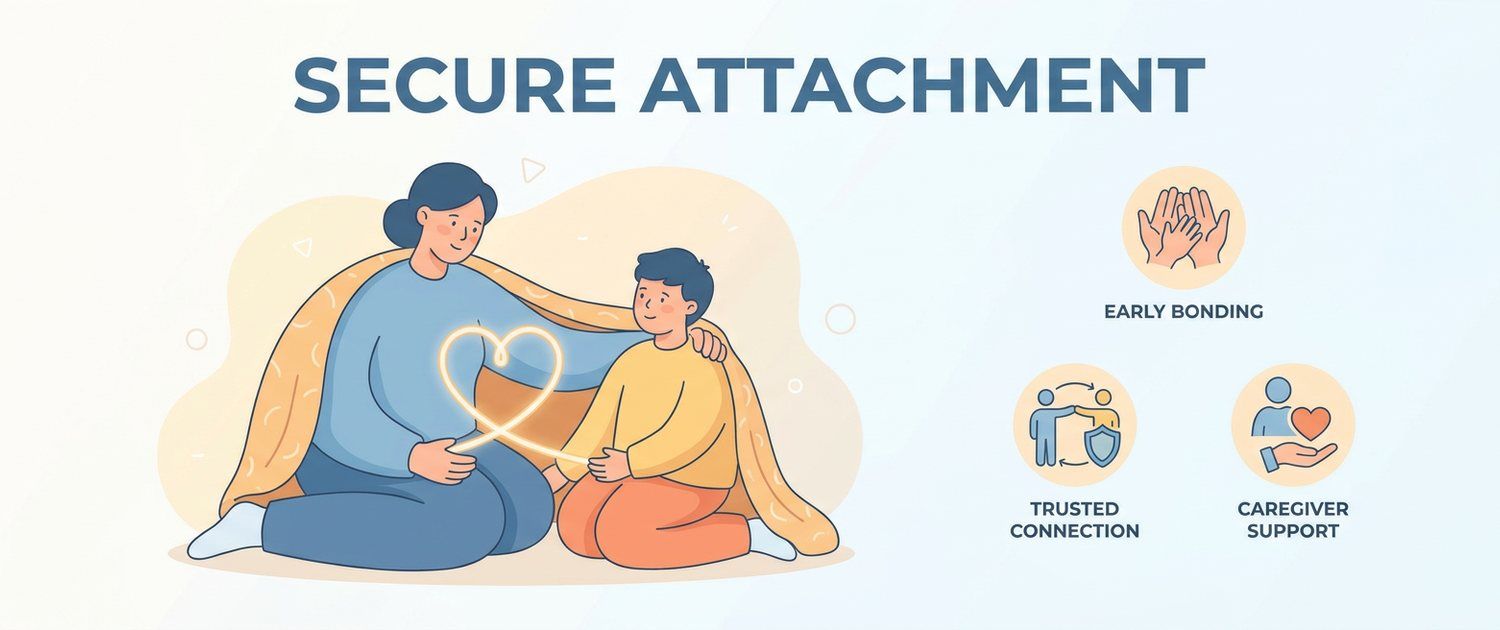
Secure attachment is the region of the map where both axes are low: anxiety and avoidance alike. It is the one region of the four that popular writing almost ignores, because there seems to be nothing to describe: nothing hurts. In fact it holds a very concrete set of skills — and that is exactly what makes security achievable rather than innate.
What the secure attachment style is
Formally: low anxiety (a threat to the bond does not capture all attention) with low avoidance (closeness does not require constant retreat). Practically it means three things: the person can lean on another, can let another lean on them, and experiences a pause as a pause. The other three regions describe what happens when one of those capacities comes at a price; the overview is in the guide to attachment styles.
An important caveat: secure attachment is not a character or a temperament. The same person can sit closer to the secure region in one relationship and further from it in another — that is a property of the construct, not inconsistency.
Signs of secure attachment
- A pause reads as a pause. No reply for two hours means "busy", not "it is over".
- Asking for support is not humiliating. "I feel bad right now, stay close" is said without internal bargaining.
- Conflict does not equal a breakup. A quarrel stays an episode, not a survival test for the relationship.
- A refusal is bearable. "Not today" is heard as information, not as rejection.
- Boundaries without guilt. You can say "I need some time alone" without turning it into a departure.
- A stable inner story about yourself. A bad day does not rewrite the conclusion that you are fine.
None of these comes for free: nearly every one is a trainable skill.
Secure attachment in relationships
A secure partner works as a stabiliser: they lower the amplitude for both anxious and avoidant partners, because they confirm neither catastrophe — neither "I will be abandoned" nor "I will be swallowed up". A meta-analysis shows an important asymmetry: relationship satisfaction is affected more by your own insecurity than by your partner's. Hence the practical conclusion — start with your own axis rather than with re-educating the other. The combinations are covered in attachment style compatibility.
Earned security: what the research shows
The term earned security describes people whose past relationships were insecure but who developed security in adulthood. This is not journalism: the phenomenon is documented, and the review covers 24 empirical studies. The main described mechanism is "attachment substitutes" — significant relationships that provide a new experience of responsiveness: a partner, a friend, a mentor, a therapist.
A second source of data is a 59-year longitudinal study: both anxiety and avoidance decline on average with age, and relationship experience predicts the decline. In other words, the direction of travel is the norm rather than the exception.
Can an attachment style change: honestly about timescales
We will not claim "change your type in a month", because the data say otherwise:
- in psychotherapy security rises and anxiety falls consistently;
- the results on avoidance are mixed — that axis changes more slowly and less reliably;
- change takes years rather than weeks, and it is usually tied to real experience rather than to insight.
Insight is not useless, though: it turns an automatic reaction into a noticed one, and a noticed reaction can be left unperformed.
Five steps that genuinely move the needle
- Separate fact from interpretation. The cheapest and most effective move for the anxiety axis.
- Separate a pause from a disappearance. The key move for the avoidance axis: saying you will be back is not closeness, it is information.
- Practise small requests. Security grows not out of big conversations but out of repeated evidence that asking is safe.
- Notice the threshold. Especially if both axes are high: the fearful-avoidant region lives on amplitude.
- Choose experience over ideas. A relationship you can lean on moves you further than any theory about where the type came from.
It is more useful to start with facets than with a label: the attachment style test shows all 12 facets separately, and usually one or two are visibly pulling the point hardest.
What security does not mean
It does not mean the absence of anxiety, jealousy or a wish to be alone — everyone has those. It does not mean relationships will be easy: a secure person grieves breakups too. And it does not mean invulnerability: emotional dependency and the fear of intimacy are states you can fall into from any point on the map if circumstances line up.
When it is not about attachment at all
If "I used to be calmer and now everything gets to me", that may be a bodily state rather than a shift on the map. Chronically high cortisol, low vitamin D, iron and B12, and thyroid problems all reduce tolerance for uncertainty and sharpen every reaction. An attachment style does not change like that in six months. If you already have results, our service can read them and point out what to discuss with your doctor.
This article is for information only. An attachment style is not a diagnosis and not a judgement of a person — it describes how they handle closeness today.
For informational purposes only
This article is for informational purposes only and does not constitute medical advice, diagnosis, or treatment. Please consult a healthcare professional for medical guidance.