Emotional Dependency in Relationships: Signs and What to Do
Reviewed by the LabReadAI medical team
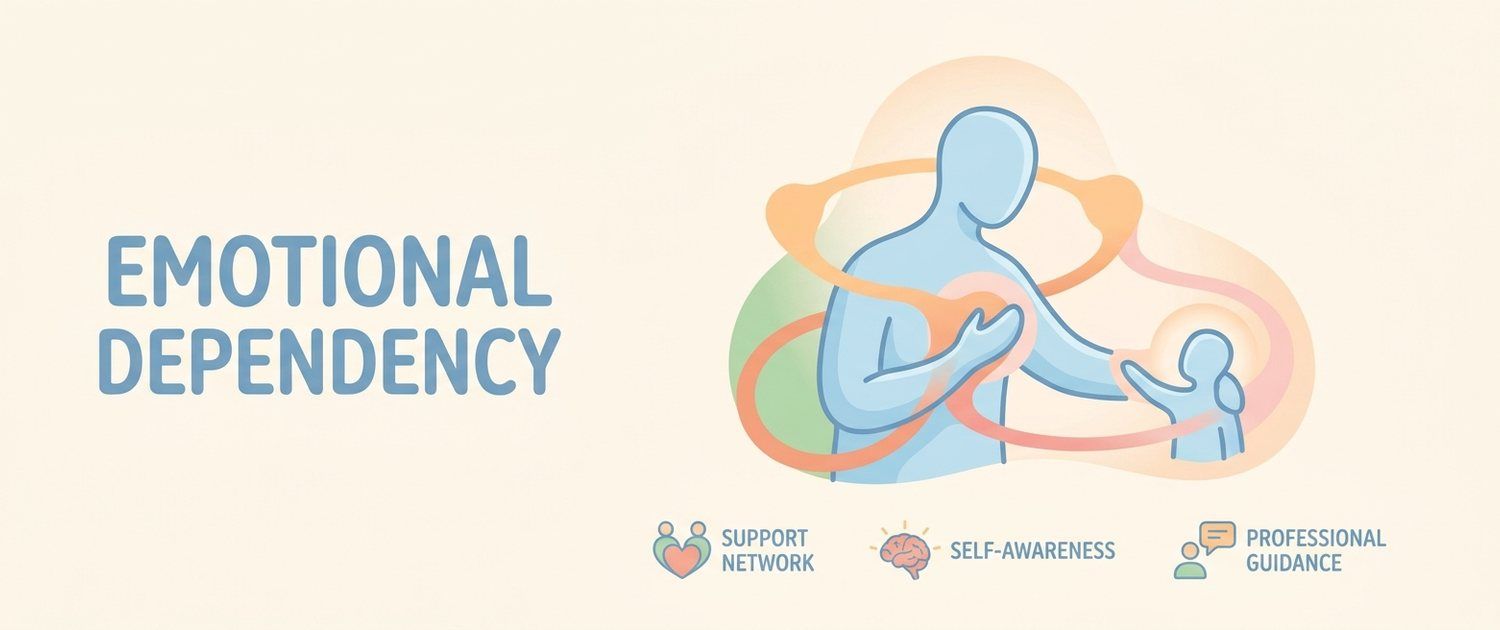
"Emotional dependency" is not a diagnosis or a separate illness. It is the everyday name for a state in which a person's inner balance is entirely tied to one other person: their tone, reply speed and mood decide what your day will be like. In the language of attachment psychology this is a strongly pronounced anxiety axis — the same mechanism described in the anxious attachment style, taken to the point where daily life notices it.
What emotional dependency is
The key detail: dependency is not about the amount of love but about the source of stability. If the only way to regain calm is a confirmation from one specific person, the system runs as a closed loop: anxiety grows, contact briefly relieves it, and the relief reinforces the mechanism. Hence the paradox — the more often you check, the shorter the effect lasts.
Signs of emotional dependency
- The day's mood is set by someone else's reply. A warm answer and the day is good; no answer and the day is lost.
- Constant checking. Online status, last seen, re-reading conversations; a background that never switches off.
- A narrowing life. Tasks, friends, sleep and interests slide into second place — sometimes imperceptibly, over a few months.
- Fear of any pause. A pause is not experienced as a pause; it demands an immediate explanation.
- Accepting terms that do not suit you just so the connection is not broken.
- Self-worth on loan. "I'm fine" exists only while it is being confirmed from outside.
- Being unable to let go after a breakup — the relationship continues mentally for months.
Everyone has one of these at some point. Dependency is the word for when many of them hold for a long time.
Love addiction: what research says
Researchers use the term love addiction carefully: it is not an official diagnosis, but as a measurable construct it is studied actively. A systematic review with meta-analysis shows a robust link between love addiction and insecure attachment — above all with its anxiety dimension. A separate line of research connects pathological affective dependence with the fear of intimacy: in some people both poles are pronounced at once, and then the picture is closer to the fearful-avoidant region.
The practical meaning is simple: it is worth working not on "dependency" as a separate entity but on the attachment mechanism it grows from.
Dependent relationships and the anxiety axis
Three familiar storylines usually show up in dependent relationships:
- Jealousy and control — the behavioural outlet of anxiety, covered separately in jealousy in relationships.
- A pull towards people who keep their distance — unpredictable responsiveness reinforces dependency more strongly than steady responsiveness does; see the emotionally unavailable partner.
- A fear of being left alone, often confused with the fear of intimacy though they are opposites: the fear of intimacy is about the cost of contact, not about losing it.
The overall map on which all this sits is in the guide to attachment styles.
How dependency differs from strong love
| Strong attachment | Dependency |
|---|---|
| Expands life: plans, energy, interest appear | Narrows it: everything else fades |
| A pause is bearable | A pause is unbearable |
| Self-worth is your own | Self-worth is on loan |
| A refusal hurts | A refusal annihilates |
| "I feel good with you" | "I feel awful without you" |
Not one line is about the strength of feeling. The difference is whether the person keeps their own footing.
How to overcome emotional dependency
"Overcoming" here does not mean falling out of love or shutting down. It means regaining more than one source of stability.
- Rebuild the frame of your life. Sleep, movement, tasks, two or three live contacts. This is not "distract yourself": dependency loses its fuel when the day stops consisting of waiting.
- Postpone the check rather than ban it. A twenty-minute delay teaches the system that calm is reachable without contact. A total ban raises anxiety.
- Separate fact from interpretation. "No reply" is a fact; "he doesn't need me" is a hypothesis. Written separately, they stop fusing.
- Ask directly. "I'm anxious, tell me we're okay" costs less than a check staged through a fight.
- Work on a facet, not a label. In one person the fear of rejection is loudest, in another self-blame, in another preoccupation. That is different work; the reference point is the secure attachment style.
To see which facet pulls you hardest, the attachment style test scores all 12 separately instead of reducing them to a single word. A separate question is whether your sense of dependency matches how the other one sees the same relationship. That can only be measured together: both answer the same questions in the compatibility test for two.
When to see a professional
See a psychotherapist if the state has held for months and taken over everything: sleep is gone, work is falling apart, and thoughts appear that life without this person has no meaning. Low mood should be assessed separately — for example with a clinical scale such as the depression test. And separately: if a relationship makes you fear for your safety, this is not about attachment or dependency and needs real-world help.
When it is not about attachment at all
Constant anxiety, an inability to settle and low mood can be amplified by the body. Chronically high cortisol with depleted DHEA-S, low iron, B12 and vitamin D, and thyroid problems all make uncertainty harder to bear; the role of serotonin is discussed in the same context — although measuring it in blood to judge mood is meaningless, and we do not suggest it. If you already have results, our service can read them in plain language.
This article is for information only and does not replace a professional consultation. Emotional dependency is not a diagnosis but a description of a state.
For informational purposes only
This article is for informational purposes only and does not constitute medical advice, diagnosis, or treatment. Please consult a healthcare professional for medical guidance.