The Fear of Intimacy: Why Closeness Starts to Suffocate
Reviewed by the LabReadAI medical team
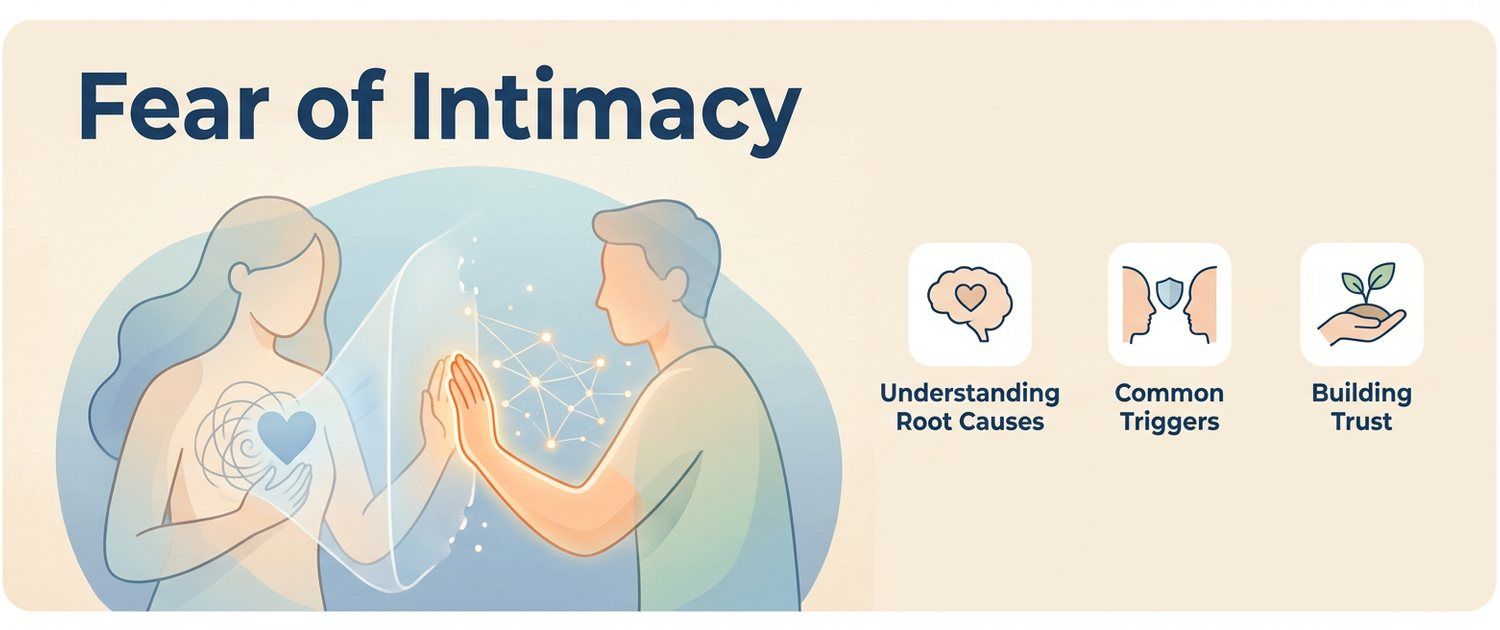
The fear of intimacy is one of the hardest experiences to explain, because from the outside it looks like indifference. A person wants a relationship, starts one, and at the moment things get genuinely close a brake switches on inside. Not "fell out of love", not "scared of commitment" — but "this is about to be too much".
What the fear of intimacy is
At its core is an expectation. Not a conscious belief but a fast automatic forecast: if I let this person all the way in, something bad will happen. The forecast comes in variants — they will see the real me and reject it; I will dissolve and stop belonging to myself; it will hurt the way it hurt before. The forecast fires before reasoning does, which is why arguing with it logically is almost useless.
In attachment terms this is most often a high avoidance axis, described in detail in the avoidant attachment style. But not always: if the anxiety axis is high as well, the picture differs — closeness is wanted and frightening at once, which is the fearful-avoidant region. The overall map is in the guide to attachment styles.
Why closeness starts to suffocate
"Suffocating" is an accurate description of the bodily side. When closeness crosses the threshold of tolerance, a physiological threat response kicks in: the chest tightens, you want fresh air, small things start to irritate. The brain interprets this in the way available to it — "I feel bad here, I need to leave" — and looks for the cause in the partner, because there has to be a cause.
Hence the typical paradox: the urge to step back appears not during a fight but after a good evening. A good evening is closeness — that is, the stimulus.
Signs of the fear of intimacy
- A retreat after getting closer. Especially after an open conversation or shared plans.
- Nitpicking out of nowhere. A partner's small flaws suddenly become significant — distance built without explanation.
- "I avoid relationships" as a stance. Rationalised: wrong time, wrong person, too busy.
- Not letting people get close in friendship either. The fear rarely stays inside romance.
- Comfort at a distance. Messaging is easier than meeting, long distance easier than living together.
- Fear of commitment alongside wanting it. An inner contradiction usually explained away as "I just haven't met the right person".
Fear of intimacy and fear of rejection are not the same
They get confused constantly, and they work in opposite directions:
| Fear of intimacy | Fear of rejection |
|---|---|
| The threat is contact | The threat is losing it |
| Reaction: step back | Reaction: chase |
| "It's too much for me" | "They will leave me" |
| Avoidance axis | Anxiety axis |
The fear of rejection is covered in the anxious attachment style. Both can live in one person at once — and then the "drawn in, then suffocated" cycle appears. Emotional dependency belongs to the opposite axis and is related only in that it often coexists with a fear of close relationships in the same person.
Causes of the fear of intimacy
There are three durable sources, and they add up rather than exclude each other:
- Experience where openness cost dearly. Relationships in which openness was used against the person. Research links a history of emotional abuse with the adult fear of intimacy, through rejection sensitivity and attachment style.
- An early history of responsiveness. If expressing a need systematically failed, suppression became more efficient than asking. The mechanism is described in Bowlby and Ainsworth's attachment theory.
- Experience of losing yourself. Relationships where you had to give up your own plans, people and boundaries. Closeness then honestly associates with disappearance, and "suffocating" becomes a defence of autonomy.
Separately: if closeness is not happening because the other person keeps you out, that is a different situation, covered in the emotionally unavailable partner.
How to stop fearing intimacy
Not by resolve. A forecast is tested by experience, and experience accumulates in small steps:
- Shorten the step rather than abolish distance. The threshold is breached by amplitude: small increments pass where large ones set off alarm.
- Name the reaction out loud. "It just got too close, and it is not about you" is a sentence that keeps contact and takes the blame off your partner at the same time.
- Separate a pause from a disappearance. Say you will be back, and come back. Repetition matters more than duration.
- Test the forecast instead of confirming it. Nitpicking after closeness is not information about your partner but a way to restore distance; noticing that is already enough not to act on it.
- Aim at experience, not at an idea. The reference point is not "becoming open" but regaining choice: the secure attachment style is not an absence of the need for air but the ability to talk about it.
To find where your threshold runs and which facet holds it, the attachment style test scores 12 facets separately instead of reducing them to the word "avoidant". A threshold is a two-sided thing: what one person reads as a normal pause the other reads as disappearing. Both versions can only be seen together — that is what the compatibility test for two is for.
When it is already an anxiety disorder
The fear of intimacy is not a diagnosis. But if anxiety spreads beyond relationships — to meetings, calls, any situation of being evaluated — it is worth checking separately: the anxiety test takes a minute. Social anxiety and avoidant personality disorder are conditions a professional works with, and they need a different approach from an attachment style.
When it is not about attachment at all
If "it got tight" appeared recently and comes with physical symptoms, look at the body. Chronically high cortisol, hyperthyroidism, low iron and vitamin D all reduce tolerance for any strain — including the strain of closeness; hypothyroidism, conversely, brings apathy and a drop in interest in contact. A reasonable minimum is TSH and the basics. If you already have results, our service can read them in plain language.
This article is for information only and does not replace a professional consultation.
For informational purposes only
This article is for informational purposes only and does not constitute medical advice, diagnosis, or treatment. Please consult a healthcare professional for medical guidance.