Fearful-Avoidant Attachment: The Signs and the Push-Pull
Reviewed by the LabReadAI medical team
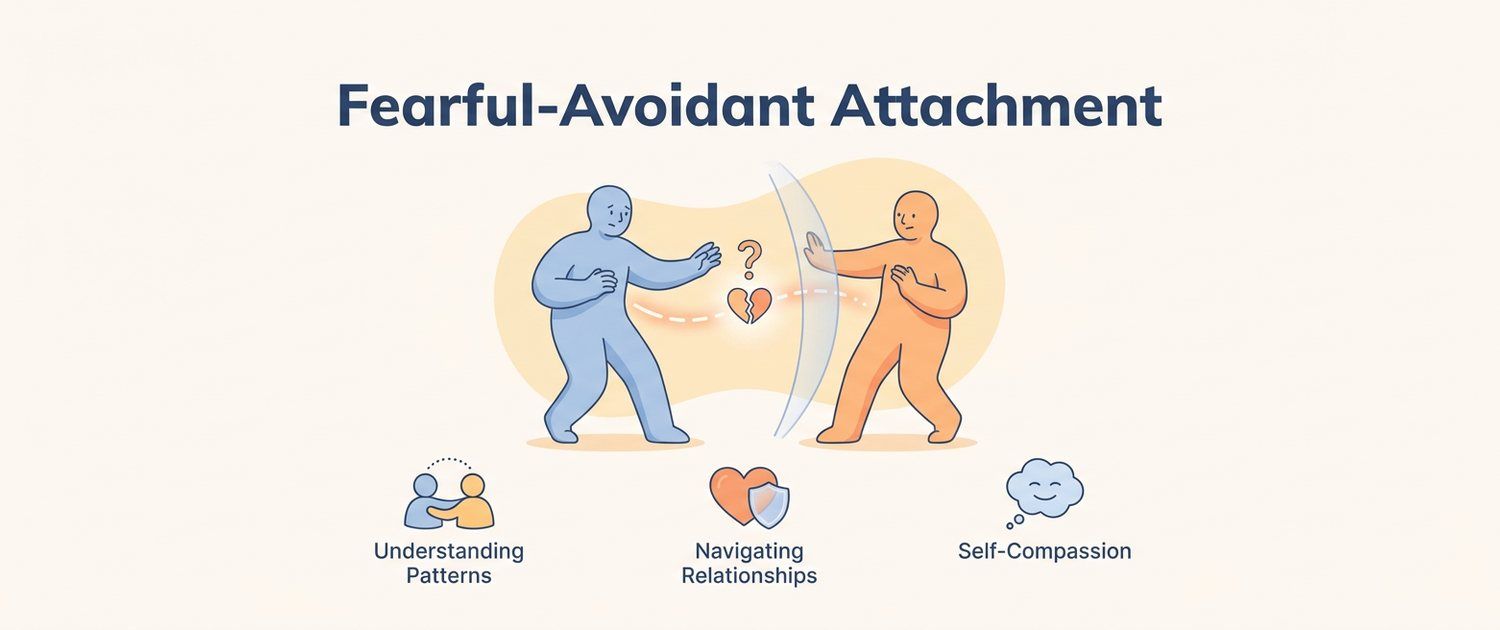
Fearful-avoidant attachment is the most awkward region of the map to describe: both axes are high here. The person needs closeness (the anxiety axis) and finds closeness hard (the avoidance axis). Two mechanisms fire on the same stimulus and pull in opposite directions — producing the picture others call a push-pull, and the person themselves calls "I don't understand myself".
What fearful-avoidant attachment is
In the four-category model this region is called fearful. The logic is simple: both approaching and withdrawing feel unsafe. Approach means risking rejection; withdraw means risking loss. Neither strategy delivers lasting calm, so they alternate. For comparison: in anxious attachment only hyperactivation runs, in avoidant attachment only deactivation; here both do. The overall map of four regions is in the guide to attachment styles.
Signs of fearful-avoidant attachment
- Wanting closeness and fearing it at once. Not in turn, but in the same moment.
- A sharp retreat after getting closer. Especially after an open conversation or a good evening.
- Distrust of things going well. A calm stretch brings not relaxation but the expectation of a catch.
- Difficulty naming your own state. Inside there is "go away" and "stay" together, and words do not fit it well.
- Strong reactions to both distance and pressure. Both poles register as a threat.
- A relationship history of extremes. Fast closeness and equally fast endings.
No single item defines the type: it is set by the combination of two axis scores, and a correct result is a point's coordinates rather than a label.
How the push-pull actually works
A push-pull is rarely manipulation. The mechanics usually go like this:
- Closeness reaches the threshold at which the avoidance axis switches on — it becomes "too much".
- The person withdraws: writes less, buries themselves in work, turns formal.
- Distance activates the anxiety axis — the fear of losing switches on.
- They come back, sincerely, with warmth and apologies.
- The return runs into the same threshold again.
From outside it looks like inconsistency; inside it is two truths at once. That is why "I won't do it again" does not help: the cycle rests on a threshold, not on a decision.
Parts of this cycle get searched for separately: the chasing phase as emotional dependency and jealousy, the retreat phase as the fear of intimacy.
Disorganised, mixed, fearful — a difference of words only
"Disorganised attachment" is a term from the childhood classification, where a child shows contradictory behaviour on reunion with an adult. Adult literature calls the same region fearful-avoidant; popular writing calls it a mixed type. There is no substantive difference. The only real confusion is with anxious-ambivalent, which belongs to the pure anxiety axis rather than to the mixed region.
Fearful-avoidant attachment in relationships
A partner usually reads only the second half of the cycle and concludes "they are playing games". It is more useful to assume both moves are real and to discuss thresholds rather than motives: after what exactly does the urge to withdraw switch on, and what helps a return without a breakup. How different regions of the map coexist in a couple: attachment style compatibility.
Where two high axes come from
The robust explanation: where the same person was both a source of safety and a source of fear, both strategies became necessary — and neither became primary. This is not a verdict handed down by origin: more on the roots in Bowlby and Ainsworth's attachment theory. Longitudinal data show both axes declining on average with age, with relationship experience predicting the decline.
What to do
- Stop choosing between the two impulses. Both are real; the task is not for one to win but to notice the threshold.
- Name the cycle out loud. "When it gets close I need to step back, and it is not about you" removes half of the other person's anxiety.
- Shorten the step. A swing lives on amplitude: small increments of closeness break the threshold less often than large ones.
- Work facet by facet. Fighting the "type" is especially pointless here: in one person the fear of rejection is louder, in another it is distrust of leaning on anyone.
- Keep a reference point. Where to move is described in the secure attachment style.
To split both axes into 12 facets and see where your threshold runs, the attachment style test helps: the mixed region is nearly unreadable without a coordinate-by-coordinate breakdown.
When it is not about attachment at all
Sharp "drawn in — suffocated" swings are worth rechecking if they are recent and come with physical symptoms. Similar instability is produced by sleep problems (disrupted melatonin, apnoea), chronically high cortisol, nutrient deficiencies and fluctuating thyroid hormones. This does not explain the type, but it explains the amplitude. If you already have results, our service can read them in plain language.
This article is for information only. Fearful-avoidant attachment is not a diagnosis and not a personality disorder. If a relationship makes you fear for your safety, reach out to a specialist or a crisis line.
For informational purposes only
This article is for informational purposes only and does not constitute medical advice, diagnosis, or treatment. Please consult a healthcare professional for medical guidance.