Attachment Styles: What Types Exist and How to Find Yours
Reviewed by the LabReadAI medical team
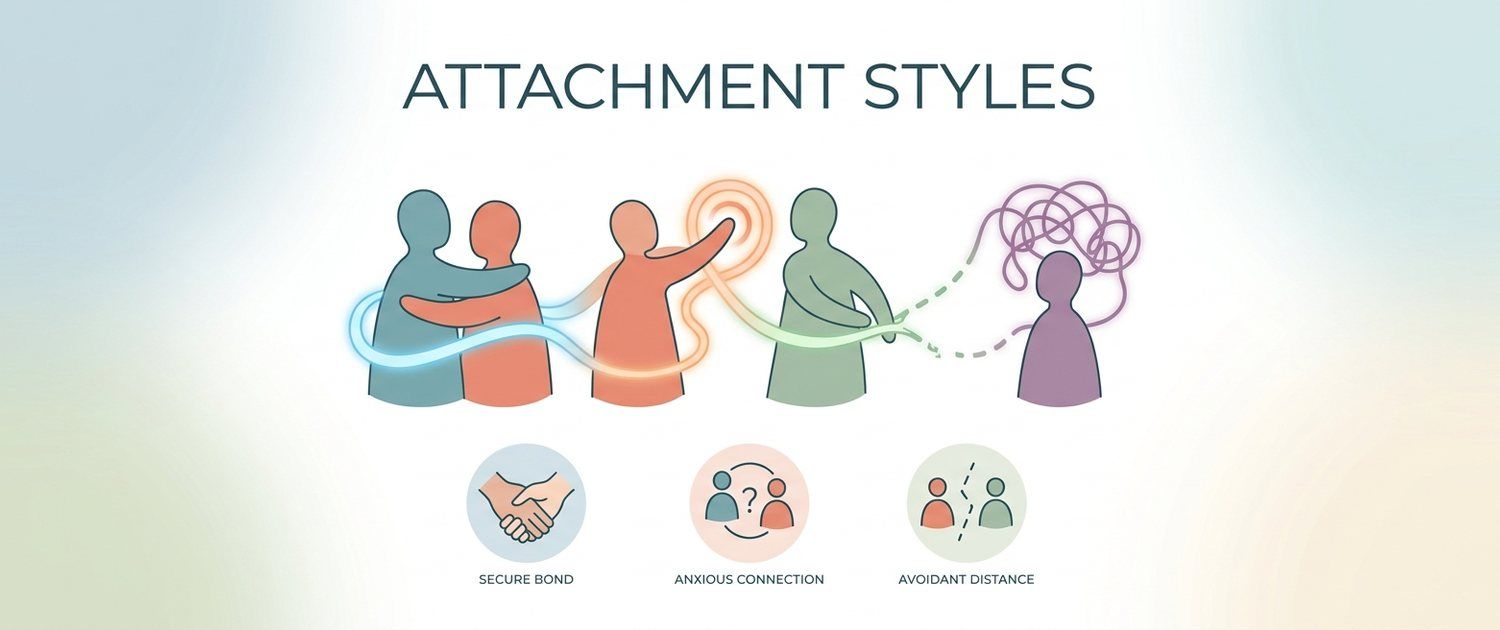
An attachment style is a stable way of behaving in close relationships: how easily a person lets others in, how they cope with a pause or distance, whether they can ask for support and lean on someone. Attachment is not about the strength of your feelings or how much you love. It is about what switches on inside when closeness feels threatened: some start chasing, others start backing away.
What attachment is and where the idea came from
The concept comes from the work of the British psychiatrist John Bowlby, who described the bond between a child and an adult as a biological system that switches on under threat and switches off when safety is near. Mary Ainsworth turned this into an observable experiment and produced the first types. In 1987 Cindy Hazan and Phillip Shaver showed that the same patterns can be read in adult romantic love — that paper is where the psychology of adult attachment begins. More on the origins in a separate piece: Bowlby and Ainsworth's attachment theory.
What types of attachment there are: the four styles in brief
The four classic descriptions that almost every popular text reduces to:
- secure — closeness is not frightening, distance is not destructive, asking for and giving support are equally possible;
- anxious (also called anxious-ambivalent or preoccupied) — closeness is badly needed, and its possible loss takes up a lot of mental space;
- avoidant (dismissing-avoidant) — closeness quickly becomes "too much", and the only real support is oneself;
- fearful-avoidant (disorganised) — closeness is wanted and frightening at the same time.
Why there are four types but only two dimensions
Modern questionnaires of the ECR family measure not a box out of four but two independent axes:
- anxiety — how quickly distance, silence and someone else's mood turn into a fear of losing the bond;
- avoidance — how much closeness a person can take and how easy it is to lean on another.
The axes are unrelated: both can be high at once, and both can be low. The four types are four regions on their map, not four different builds of the psyche. Taxometric analyses show it directly: there are no true categories in attachment, only a continuous space. So the correct answer to "what is my attachment style" is a point with two coordinates, not a single word. And if the point sits near a border, the honest thing is to say so.
The secure attachment style
Both axes are low. A quarrel does not mean the end, and a pause in messaging reads as a pause rather than a threat. Such a person can say "I feel bad right now, stay close" — and can hear the same in return. This is not a "perfect character": security is not the absence of anxiety but the ability to hold it and put it into words. What sits behind this region and how people move into it: the secure attachment style.
The anxious attachment style
High anxiety with low avoidance. A partner's silence feels like a verdict before the reason is even known; regular reassurance is needed; one's own needs feel excessive. Three things people usually search for separately grow out of the same axis: jealousy and compulsive checking, emotional dependency and the fear of rejection. The full reading of the axis is in the piece on the anxious attachment style.
The avoidant attachment style
The mirror image: avoidance is high, anxiety is low. Relationships are valuable until they become tight; asking for help is harder than coping alone; closing in triggers an automatic "I need space". The extreme form is called counterdependency. The details, the signs and the "in men / in women" myths are in the piece on the avoidant attachment style. A separate experience often mixed into it is the fear of intimacy.
The fearful-avoidant (disorganised) style
Both axes are high: closeness is needed and dangerous at once. From the outside it looks like a swing — a step forward, then a sharp retreat — and usually both moves are sincere. This region is searched for as a thing in itself more often than "secure" and "disorganised" combined. The reading: the fearful-avoidant attachment style.
How to find your attachment style
From descriptions — badly: they are written so that almost everyone recognises themselves in two or three. A workable order looks like this:
- Look at behaviour in concrete situations, not at feelings. What do you do when nobody replies for three hours? When help is offered? When it gets too close?
- Answer about a specific relationship. A style is not the same with everyone: it can differ between a parent and a partner, and that is a property of the construct, not a measurement error.
- Score both axes separately. That is the only way "anxious" and "fearful-avoidant" come apart: in descriptions they look alike, on the map they sit in different corners.
- Account for response bias. Questionnaires include reverse-keyed items precisely to catch the habit of answering more dramatically — or more "correctly" — than is true.
Doing all that by yourself is hard, so we built the attachment style test: 48 statements, a point on the map of two axes and the 12 facets it is made of. Taking it is free and the point appears straight away.
Attachment styles in relationships: what happens in a couple
A style does not decide a couple's fate, but it explains the recurring arguments. The classic plot is one partner needing to be closer while the other needs air: in longitudinal research such couples turn out to be surprisingly stable at fairly low satisfaction — stability and happiness are not the same thing here. An important detail from a meta-analysis: satisfaction is affected more by your own insecurity than by your partner's, so starting with your own axis is more useful. The combinations are covered in attachment style compatibility. And if the real pattern is being drawn again and again to people who keep their distance, that is its own story: the emotionally unavailable partner.
Can an attachment style change
Yes, and this is a measured fact rather than a consolation. A 59-year longitudinal study showed that both anxiety and avoidance decline on average with age, and relationship experience predicts that decline. The move towards security in adulthood has its own term in the literature: earned security. The honest caveat: in psychotherapy security rises and anxiety falls consistently, while the evidence on avoidance is mixed — there is no fast way to "switch types".
When it is not about attachment at all
The body does not explain a relationship style, but it can imitate one. Irritability, withdrawal, a vanished interest in closeness and constant edginess are typical of hypothyroidism, low iron and vitamin D, and of chronically raised cortisol. If "I have gone cold" or "I am on edge all the time" appeared over recent months rather than being lifelong, it is reasonable to look at TSH and the basics too: an attachment style does not change that fast, while a thyroid gland easily can. If you already have results, our service can read them in plain language.
This article is for information only. An attachment style is not a diagnosis and not a verdict — it describes how you answer today. If a relationship makes you fear for your safety, reach out to a specialist or a crisis line.
For informational purposes only
This article is for informational purposes only and does not constitute medical advice, diagnosis, or treatment. Please consult a healthcare professional for medical guidance.