The Emotionally Unavailable Partner: Why We Chase Them
Reviewed by the LabReadAI medical team
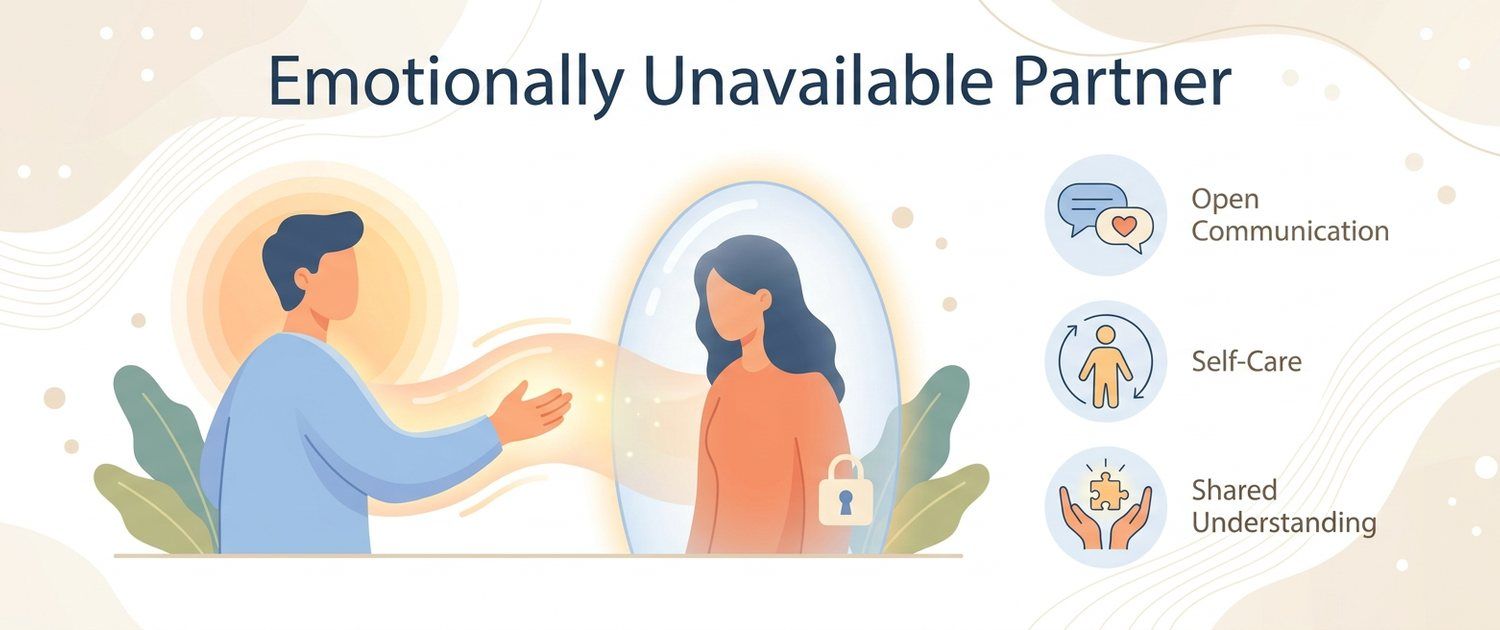
"An emotionally unavailable partner" is a phrase from life rather than from a textbook, and it describes a very specific experience: the person is there, the relationship formally exists, but any attempt at closeness meets no response. Conversations about feelings get diverted, plans are not made, and the question of what is happening between you hangs in the air. Here is what it looks like, why people fixate on such partners so often, and what can genuinely be done.
Who counts as an emotionally unavailable person
A caveat first, without which the rest would be dishonest: this is not a diagnosis or a personality type. Emotional unavailability describes observable behaviour, not a conclusion about someone's inner workings. The same picture can be a high avoidance axis, exhaustion, depression, a hormonal problem, a different life stage, or simply not wanting this relationship. From the outside all of those look identical.
If a stable style really is the case, the closest description is the avoidant attachment style; the overall map is in the guide to attachment styles.
Signs of emotional unavailability
- Talk about feelings drifts away. Not conflict, just a soft sliding off the topic.
- The future is not discussed. Plans exist for a week but not for a year.
- Closeness is rationed. Good evenings happen, and a pause usually follows.
- Requests for support go unanswered — not out of malice, but as if they missed.
- The relationship is not named. The status stays vague for longer than is comfortable for you.
- Hot and cold. The cycle repeats so evenly you could set a clock by it.
Important: ticking these boxes does not entitle anyone to hand out a label. This is a language for describing what happens to you around a person, not a verdict on them.
Why we are drawn to people who keep their distance
The most common explanation in popular writing — "childhood trauma" — is too general to be useful. The working explanation is more specific: it is about the reinforcement schedule.
A steady response calms the attachment system: the signal landed, the anxiety switches off. An unpredictable response — sometimes there, sometimes not — never switches it off, so the system keeps trying to obtain confirmation. That is why a relationship with someone who runs hot and cold feels subjectively more intense than a calm one: the intensity comes not from the depth of the bond but from unclosed anxiety. That is how the sense of falling for people who do not love you forms, though the choice was not about them but about a familiar mechanism.
Hence the practical conclusion: if this is your pattern, the work belongs with the anxiety axis and with emotional dependency, not with the search for the "right" partner. An extra layer is jealousy: in this scenario it is almost inevitable, because uncertainty is exactly what produces it.
Why relationships never seem to work: three common versions
- A selection pattern. A calm response reads as "boring" because it does not deliver the familiar spike. Easy to test: recall who you filtered out, and why.
- Your own distance. Sometimes the partner is not the only unavailable one. If closeness makes you want to step back, the closer reading is the fear of intimacy.
- A real mismatch of intentions. The person does not want the relationship you want. That is not a pathology or an attachment style — it is a fact, and better heard early.
The emotionally unavailable man: myth and data
The phrase "emotionally unavailable man" appears in search several times more often than its female counterpart, but that is about language rather than psychology. The meta-analysis of sex differences in adult attachment shows men scoring slightly higher on avoidance, but the effect is small and the spread within each sex is many times larger. Unavailability is not a male trait; it is simply named that way more often when the person is a man.
What you can do
- Separate observation from conclusion. "Has not discussed the future for two months" is an observation. "He is afraid of intimacy" is a conclusion you cannot verify.
- Test with words, not with behaviour. A direct question about what kind of relationship someone wants yields more than six months of observation and of trying to "show how good it is with me".
- Stop reading distance as a task. Distance is not an invitation to shorten it further; more often it means exactly what it says.
- Look at the cycle, not the episode. How the argument about distance works in a couple: attachment style compatibility.
- Start with your own axis. Meta-analysis shows that relationship satisfaction is affected more by your own insecurity than by your partner's.
Your half of the picture is easy to see in the attachment style test: a point on the map of two axes and 12 facets from your own answers, with no absentee conclusions about the other person. No absentee conclusions are needed either where the other one is willing to answer for themselves: the compatibility test for two is taken by both separately, and distance stops being a guess — it becomes a divergence between two measured pictures.
When it is no longer about unavailability
Coldness and harm are worth separating. If you systematically feel worse around a person, doubt your own perception, and give up your plans and people, the conversation is not about distance. For that situation we have a separate instrument: the test "The person next to you" describes observable behaviour and its effect on you, without labels or absentee diagnoses. And if you start fearing for your safety, what you need is real-world help, not a test.
When "he is cold" is about health
And the most prosaic possibility. If someone changed over recent months — interest in closeness vanished, irritability and apathy appeared — keep hypothyroidism, depression, low iron and low testosterone in mind. A reasonable minimum is TSH and the basics. An attachment style does not change in a couple of months, whereas hormones easily can. If you already have results, our service can read them.
This article is for information only, does not diagnose third parties and contains no advice to leave or to stay.
For informational purposes only
This article is for informational purposes only and does not constitute medical advice, diagnosis, or treatment. Please consult a healthcare professional for medical guidance.