The Avoidant Attachment Style: Signs in Men and Women
Reviewed by the LabReadAI medical team
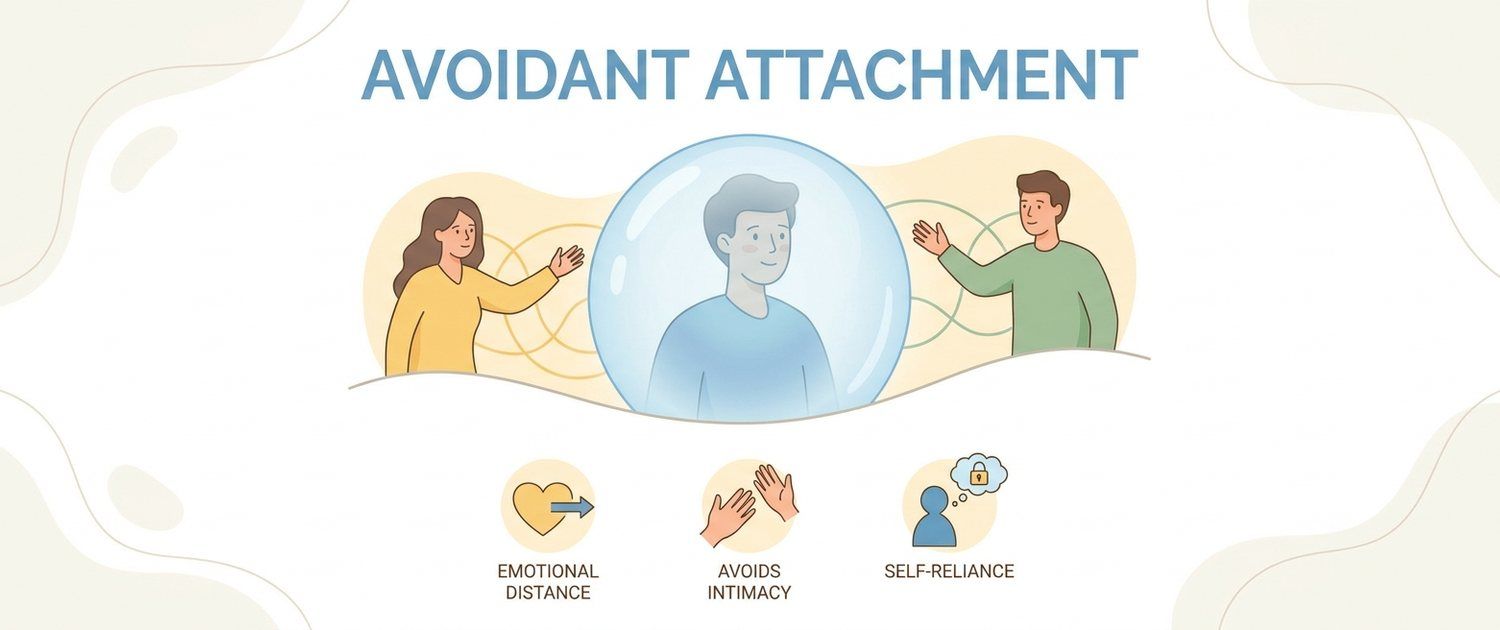
Avoidant attachment is the region of the close-relationship map where the avoidance axis is high and the anxiety axis is low. The person is not afraid of being left; they struggle when things get too close. Relationships can still matter and be valued — they simply need constant air, and asking for help feels either humiliating or pointless.
What the avoidant attachment style is
In psychology it is called dismissing-avoidant, to distinguish it from fearful-avoidant. The mechanism is described as a deactivating strategy: the attachment system is not switched off, it is suppressed. When the need for closeness comes up, so does the habit of muting it — switching to tasks, to self-sufficiency, to distance. From the outside this reads as coldness; from the inside it feels like "I'm calmer this way". The overview of all four regions is in the guide to attachment styles.
Signs of avoidant attachment
Not "I am an introvert", but concrete recurring reactions:
- Closeness feels tight. The closer the relationship, the stronger the pull to step back — often without resentment or conflict, just "I need to be alone".
- Help is harder to accept than to give. Asking is awkward; coping alone feels both faster and more honest.
- Stress leads inward. In a hard moment what is wanted is not support but quiet and solitude.
- Being closed off. Talking about your own feelings seems unnecessary: "why load someone with it".
- Relationships as one area of life. Work, tasks and personal projects easily outweigh them.
- Distrust of leaning on anyone. The inner rule is "in the end you can only count on yourself".
- Idealising a past or future partner. The present is compared with the imagined — and the distance gets its justification.
An important correction: no single item makes a person avoidant. A type is not a checklist but a combination of two axis scores, which is why a result has coordinates rather than a label.
Avoidant attachment in relationships
The most common plot is "he comes close, then pulls away", though there is really only one movement: closeness reaches a threshold, deactivation switches on, distance is restored. The partner reads it as lost interest; for the avoidant person it is a way to get their footing back. Hence the classic pair of one chasing and one withdrawing, covered separately in attachment style compatibility. If you are looking at this from the outside, from the position of the one left out, the closer reading is the emotionally unavailable partner.
Avoidance and fear of intimacy are worth separating. Avoidance is about the cost of contact — "it's too much for me"; fear is about expected pain — "this will hurt". They often travel together but need different conversations: the fear of intimacy has its own piece.
Avoidant attachment in men and in women
There are many myths here, so let us go by data. A meta-analysis of sex differences in adult romantic attachment shows that men score slightly higher on avoidance and women slightly higher on anxiety, but the effects are small, and the spread within each sex is many times larger than the gap between them. The practical conclusion is simple: avoidant attachment in women is common and looks the same, and "he's a man, they're all like that" is not an explanation but a way of not looking.
What does differ is the cultural packaging. Male avoidance is more often approved of ("independent", "doesn't whine"), female avoidance more often gets a label ("cold", "difficult"). The signs are identical.
Counterdependency: when independence becomes an obligation
Counterdependency is the colloquial name for the far end of the scale. The difference is not in strength but in freedom: healthy autonomy has an off switch, counterdependency does not. The markers:
- asking feels not awkward but like a defeat;
- any care triggers irritation or an urge to repay it immediately;
- closeness is experienced as a threat to the self, not as a risk of loss;
- your own needs are noticed last — sometimes only through physical symptoms.
This is still not a diagnosis or a personality disorder, but a description of pronounced deactivation.
Where avoidance comes from
Not directly from "a bad childhood". The robust version: avoidance forms where expressing a need systematically failed to work or came at a cost — and suppression became more efficient than asking. The adult style is then rebuilt by experience: significant relationships, losses and therapy all shift both axes. On origins, see Bowlby and Ainsworth's attachment theory; on the opposite axis, where hyperactivation rather than suppression switches on, see the anxious attachment style. And if both axes are high at once, that is a different region: the fearful-avoidant style.
What to do if you are the avoidant one
Honestly: you cannot "stop being avoidant" by willpower, and the therapy data here are more modest than for anxiety — security rises consistently while avoidance responds unevenly. What genuinely works as a direction:
- Notice the moment of deactivation. Not "I've fallen out of love" but "it got close and the urge to step back switched on". A named process is already manageable.
- Separate a pause from a disappearance. Saying "I need two hours alone, I'll come back" is neither closeness nor a concession — it is information that removes the other person's anxiety.
- Practise small requests. Not "support me" but "sit with me for ten minutes". The scale matters more than the content.
- Do not confuse the goal with remaking yourself. The point is not to become a different person but to make autonomy a choice again. What that point on the map looks like: the secure attachment style.
To see exactly where your line between self-sufficiency and deactivation runs, the attachment style test scores the six facets of the avoidance axis separately instead of handing you a single word.
When it is not about attachment at all
If withdrawal, indifference to closeness and "I don't want anything" appeared in recent months rather than being lifelong, this is no longer about a style. That is how hypothyroidism, depression, low iron and low testosterone look — all of them reduce libido, initiative and the capacity to respond. A reasonable minimum is TSH and ferritin; if you already have results, our service can read them and point out what to discuss with a doctor.
This article is for information only. Avoidant attachment is not a diagnosis and not the mark of a "bad partner" — it describes how a person handles closeness today.
For informational purposes only
This article is for informational purposes only and does not constitute medical advice, diagnosis, or treatment. Please consult a healthcare professional for medical guidance.