Bowlby and Ainsworth: Where an Attachment Style Comes From
Reviewed by the LabReadAI medical team
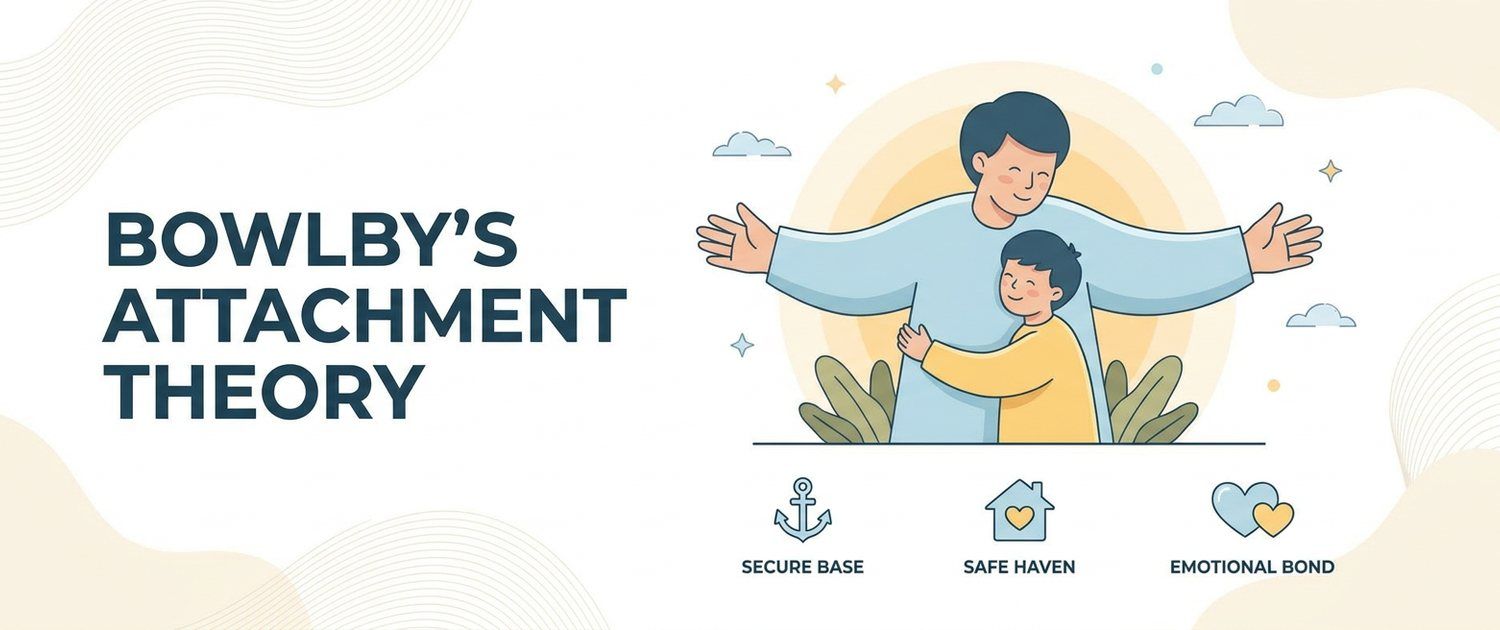
Almost everything written today about attachment styles in adult relationships grows from two sources: the theoretical work of the British psychiatrist John Bowlby and the experiments of the American-Canadian psychologist Mary Ainsworth. It is worth knowing what they actually claimed — because in popular retellings the theory usually turns into a verdict handed down by childhood, which it never was.
John Bowlby: attachment theory in brief
In the mid-twentieth century the dominant explanation was that a child clings to the mother because she feeds them. Bowlby proposed something else: attachment is an independent biological behavioural system, as basic as feeding. Its job is to keep a helpless young creature near a protecting adult. The system switches on under threat, tiredness or pain, and switches off once safety is restored.
Two consequences made the theory workable:
- a child's attachment to the mother is not "spoiling" but a developmental norm;
- the same system remains in the adult, only the signals are subtler and the attachment figure becomes a partner.
Bowlby later introduced internal working models — accumulated expectations about whether anyone will respond and whether you are worth responding to. Those expectations are exactly what modern questionnaires measure.
Mary Ainsworth and the Strange Situation
Ainsworth made the theory testable. In the Strange Situation procedure a one-year-old and their mother are placed in an unfamiliar room, then the mother briefly leaves and returns. The key moment is not the separation but the reunion: the reaction on return shows whether the adult functions as a secure base.
Attachment types in children: what the experiment showed
- Secure. The child is upset when the parent leaves, settles quickly on return and goes back to play.
- Avoidant. Outwardly almost no reaction to either leaving or returning — while physiological stress markers are raised.
- Anxious-ambivalent. Strongly distressed, and on reunion both reaches for the mother and is angry at her — settling does not happen.
- Disorganised (described later). Contradictory behaviour with no single strategy: approaching and freezing, turning away halfway.
The adult analogues of these four are the regions of the map written about today: secure, anxious, avoidant and fearful-avoidant. The overall map is in the guide to attachment styles.
How an attachment style forms
The key predictor is neither love nor the amount of time but the predictability of the response. A steady response produces security. A systematically unavailable one teaches suppression of the signal — that is how avoidance forms. An unpredictable one, sometimes there and sometimes not, teaches amplification — that is how anxiety forms. A special case is when the same adult is a source of both safety and fear: then no strategy becomes primary.
An important correction: this describes a mechanism, not an accusation against parents. Temperament, family circumstances, health, culture and plain chance all contribute.
Attachment disorder: what the term actually means
In everyday speech "attachment disorder" covers almost anything uncomfortable in relationships. In medicine it is a narrow term: attachment disorders in children are rare conditions linked to severe deprivation and institutional care, and only a specialist diagnoses them. An insecure attachment style does not belong to that category: it is a variant of the norm rather than a disorder, and a very large share of people have one.
From childhood to adult relationships
Cindy Hazan and Phillip Shaver built the bridge, showing that adult romantic love displays the same patterns. But an adult style is not a copy of early experience, and this is the most important part of the modern picture:
- the overlap between your style with a parent and your style with a partner is modest — attachment differs across specific relationships;
- both axes decline on average with age, and relationship experience predicts that decline;
- the adult move towards security is documented separately as earned security.
In other words, childhood sets the starting conditions, not the outcome. What that looks like in practice is clearest in the fear of intimacy: that is where early experience comes up most often, and where it is most visible that it does not decide everything.
What the theory does not explain
Attachment theory is one of the most testable in psychology, which is exactly why its limits are stated openly. A consensus statement by a large group of researchers records that attachment measures are not intended for decisions about individuals — in custody disputes, for instance. Two more limits:
- a self-report questionnaire and a clinical interview measure different things and barely agree with each other;
- there are no "true categories" in attachment: types are regions of a continuous two-axis space.
So a correct result is a point with coordinates and an honest caveat near a border, not a label. That is how our attachment style test is built: 48 statements, two axes and 12 facets.
What the body remembers: early stress and the adrenal axis
A separate line of research links early chronic stress to regulation of the hypothalamic-pituitary-adrenal axis — that is, to the work of cortisol and DHEA-S. Honesty is required here: these are population-level associations, and no lab test can identify an individual's attachment style — such a test does not exist. What labs genuinely can show is the current cost of chronic strain. If you already have results, our service can read them in plain language.
This article is for information only. An attachment style is not a diagnosis but a description of how a person handles closeness today.
For informational purposes only
This article is for informational purposes only and does not constitute medical advice, diagnosis, or treatment. Please consult a healthcare professional for medical guidance.