Hair Loss: Causes in Women and Men and Which Tests to Take
Reviewed by the LabReadAI medical team
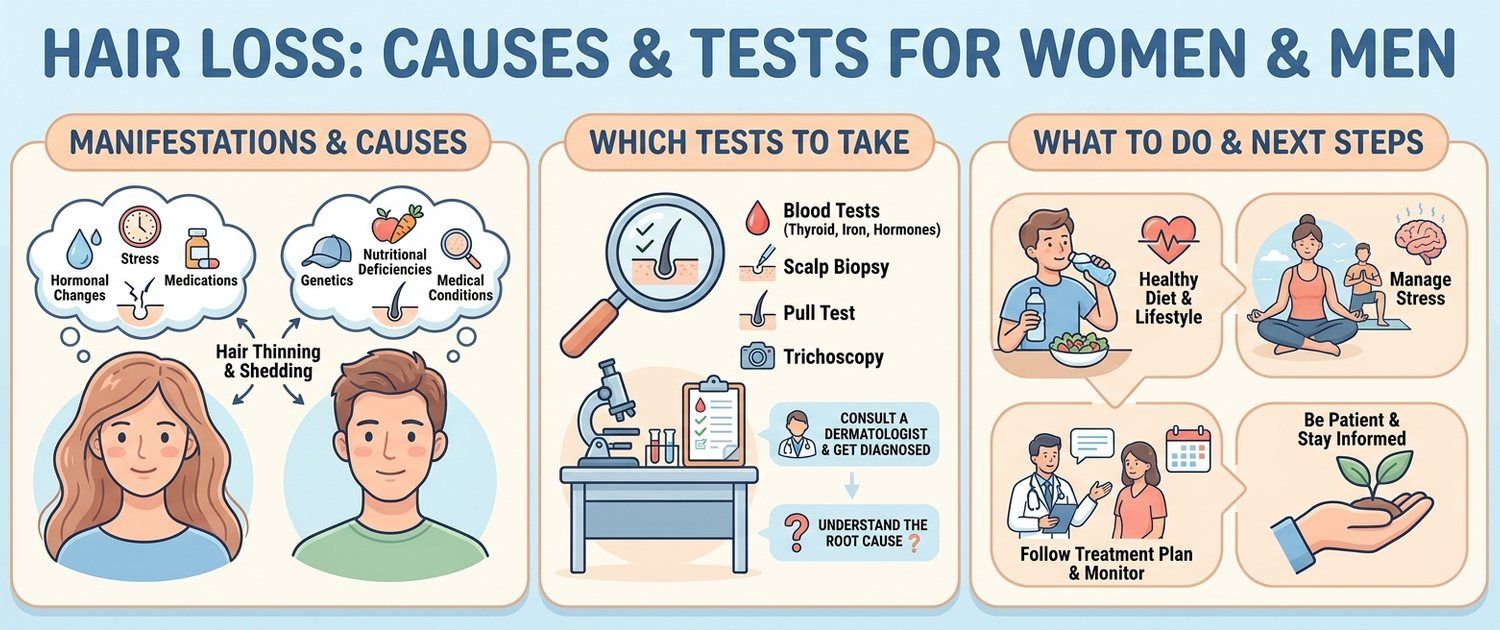
Losing a few dozen hairs a day is normal: each hair goes through a cycle of growth and shedding, making way for a new one. It becomes a concern when there are noticeably more than usual on your brush and pillow, bald patches appear, or the hair thins along the part. Increased hair loss almost always has a specific cause — from simple iron deficiency to hormonal disorders — and many of them are visible on blood tests. Here is why hair falls out and where to start the work-up.
How Many Hairs a Day Is Normal, and When It Is Hair Loss
Normally a person loses about 50–100 hairs a day. Most hairs (85–90%) are in the growth phase, the rest in a resting phase after which they shed. A problem is persistent increased shedding, visible thinning or patches without hair. It matters to distinguish diffuse loss (evenly across the scalp — usually from deficiencies and stress), loss along the part (androgenetic) and focal loss (round bald patches).
Hair loss often comes alongside other signs of deficiency — for example with fatigue and weakness. That hints the cause should be sought not on the scalp but in blood tests.
Iron Deficiency — a Common Cause of Hair Loss
A lack of iron is one of the most common and easily corrected causes of diffuse hair loss, especially in women. Hair follicles are very sensitive to iron stores, and when these are depleted some hairs shift early into the shedding phase (telogen effluvium).
The key marker is ferritin: it reflects iron stores and falls earlier than hemoglobin. Low ferritin with a still-normal blood count is a typical picture in hair loss. If the deficiency has reached iron deficiency anemia, shedding is usually more pronounced.
The Thyroid and Diffuse Hair Loss
Both reduced and increased thyroid function disrupt the hair growth cycle. With hypothyroidism hair becomes dry and brittle and thins across the scalp; weakness, feeling cold and weight gain are added. The basic screen is TSH; if abnormal, see an endocrinologist. Once thyroid function is corrected, hair growth usually recovers.
Androgenetic Alopecia: Hormones and Heredity
The most common type of balding is androgenetic alopecia. In men it is a receding hairline and thinning at the crown; in women, a widening part with a preserved hairline. It is driven by a genetically determined sensitivity of follicles to androgens, so testosterone and related hormones are among the things assessed. In women, marked androgenetic alopecia with other signs of androgen excess is a reason to rule out hormonal disorders with an endocrinologist or gynaecologist.
Alopecia Areata and Other Causes
Alopecia areata — round patches without hair — is an autoimmune condition in which the immune system attacks follicles; it usually needs a dermatologist's review. Scarring forms (with redness, scaling and irreversible hair loss) are a separate group, also managed by a dermatologist. Telling scarring loss from reversible diffuse loss matters, because the approach differs.
Vitamin Deficiencies and Stress (Telogen Effluvium)
Sudden diffuse shedding 2–3 months after stress, illness, childbirth, a crash diet or surgery is telogen effluvium: many hairs synchronously enter the resting phase. It is reversible once the trigger is removed. Deficiencies contribute too — low vitamin D and zinc are linked to poorer hair condition. Crash diets and lack of protein also provoke shedding.
Which Blood Tests to Take for Hair Loss
A sensible starting set for diffuse hair loss:
- Ferritin and a complete blood count — to find hidden iron deficiency and anemia (iron studies).
- Thyroid hormones — TSH and related markers.
- Vitamin D, zinc, and in women with signs of androgen excess — sex hormones.
It is convenient to take the key markers as a single hair loss blood panel.
If you want a quick orientation for your situation, you can describe your complaints and attach a photo — the service suggests likely causes and which tests to discuss with your doctor.
When to See a Doctor
See a dermatologist or trichologist if: patches without hair or areas of redness and scarring appear; shedding is rapidly increasing; the part widens in a woman with acne and excess facial or body hair; or hair loss comes with marked weakness, weight change or other symptoms. In most cases of reversible loss the cause is found on blood tests and corrected, and hair recovers over a few months.
In men the pattern is usually different: most often it is androgenetic alopecia — a receding hairline and thinning at the crown. How to tell it from hair loss whose cause shows up in blood tests is covered in hair loss in men.
This article is for informational purposes only and does not replace a doctor's consultation. Diagnosis and treatment are the task of a dermatologist, trichologist or endocrinologist.
For informational purposes only
This article is for informational purposes only and does not constitute medical advice, diagnosis, or treatment. Please consult a healthcare professional for medical guidance.