CA 19-9 Tumour Marker: Normal Levels, Causes and Interpretation
Reviewed by the LabReadAI medical team
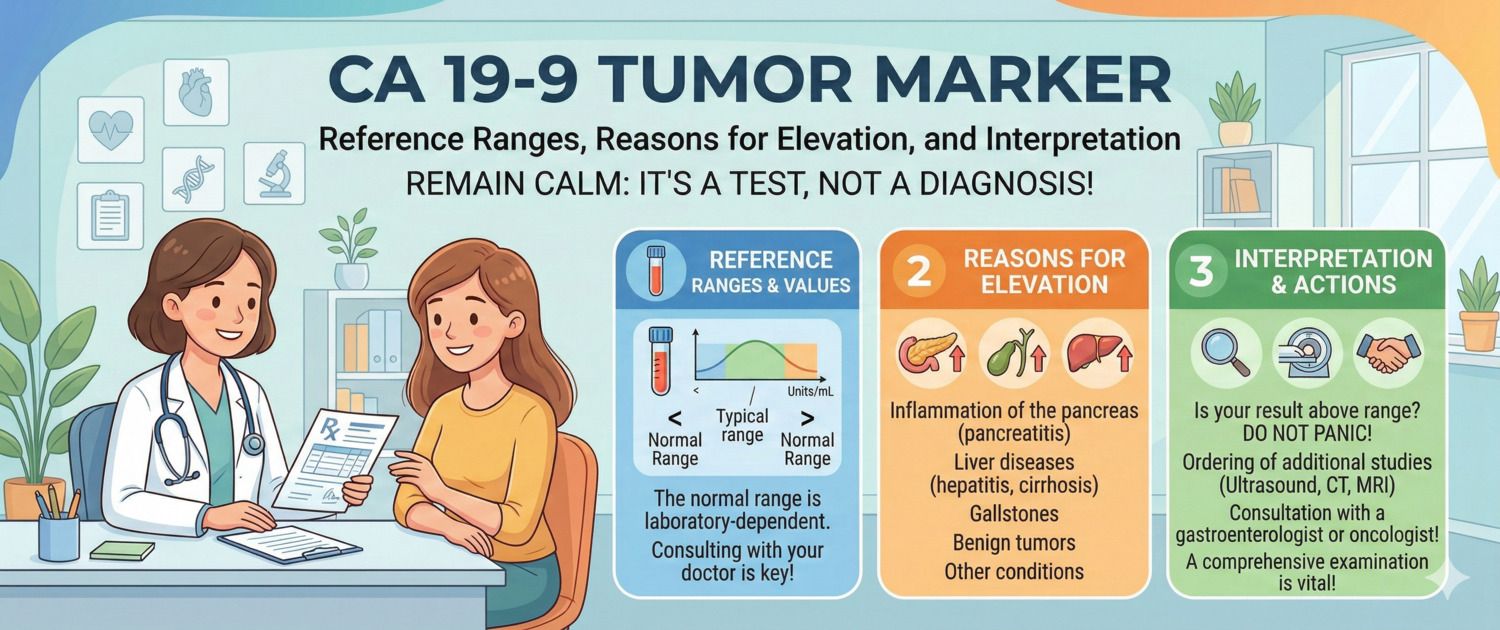
CA 19-9 is one of the few tumour markers that can rise dramatically in conditions entirely unrelated to cancer. Jaundice, gallstone disease and pancreatitis can push CA 19-9 tens of times above the normal range — none of which is malignancy. Understanding the difference between a "dangerous" and a "benign" elevation is essential for correct interpretation of this result.
What Is CA 19-9 and Where Is It Used
CA 19-9 (carbohydrate antigen 19-9) is a sialylated Lewis blood group antigen produced by the epithelium of the gastrointestinal tract and biliary system. Under normal conditions only trace amounts circulate in the blood. When these cells are affected by malignant transformation or certain inflammatory processes, CA 19-9 synthesis increases substantially and the antigen enters the bloodstream at measurable concentrations.
Like other tumour markers — CEA and CA-125 — CA 19-9 is not a diagnostic test for cancer. Its primary clinical roles are:
- Treatment monitoring of pancreatic cancer, cholangiocarcinoma, and gastric cancer. The dynamics of CA 19-9 after surgery or chemotherapy are a key criterion of treatment response.
- Early recurrence detection — rising CA 19-9 after normalisation precedes clinical and CT evidence of disease return by several months.
- Prognostic assessment — a very high baseline level (> 1000 U/mL) in pancreatic cancer correlates with unresectability and a worse prognosis.
- Supplementary marker for mucinous ovarian tumours — used together with CA-125.
The test is part of the standard tumour marker panel.
An important biological caveat: approximately 5–10% of people genetically lack the Lewis antigen (Lewis-negative phenotype, Le(a-b-)). In these individuals, CA 19-9 is zero or undetectable regardless of whether a tumour is present. This means the marker is entirely uninformative in this subgroup — a negative result does not exclude pancreatic cancer.
CA 19-9 Normal Range
| Group | Normal range |
|---|---|
| Adults (both sexes) | < 37 U/mL |
The normal range is the same for men and women and does not vary substantially with age in the adult range.
Interpretation zones:
- < 37 U/mL — normal
- 37–200 U/mL — mild elevation. In most cases explained by benign causes: cholestasis, pancreatitis, gallstone disease
- 200–1000 U/mL — significant elevation. Probability of malignancy increases, but benign causes remain possible with severe cholestasis
- > 1000 U/mL — very high; in most cases a malignant process, frequently with metastases
A critically important point: in the presence of jaundice (biliary cholestasis), CA 19-9 can be substantially elevated — often reaching 500–1000 U/mL — with no tumour at all. This is a direct consequence of impaired antigen clearance through bile. CA 19-9 cannot be interpreted without knowing the bilirubin level: high CA 19-9 in the context of jaundice means resolving the cholestasis first, then reassessing the marker.
Which Cancers Are Associated with Elevated CA 19-9
Pancreatic cancer — the primary clinical application. CA 19-9 is elevated in 70–80% of patients with pancreatic cancer. Sensitivity for localised disease is lower — 50–60%; for metastatic disease — 75–85%. The central limitation: at early resectable stages, CA 19-9 is normal in a substantial proportion of patients.
Cholangiocarcinoma (bile duct cancer) — CA 19-9 is elevated in 60–80% of patients, often in the context of significant cholestasis, which further complicates interpretation.
Gastric cancer — CA 19-9 is mildly elevated in 20–40% of patients, particularly in advanced disease. Used here alongside CEA.
Colorectal cancer — elevated in 20–30% of patients; used as a supplement to CEA, not independently.
Mucinous ovarian tumours — CA 19-9 is more informative here than CA-125: mucinous cells actively express CA 19-9 while CA-125 is often normal in this tumour subtype.
Hepatocellular carcinoma — CA 19-9 is mildly elevated in some patients; the primary marker for this tumour is AFP.
Non-Oncological Causes of Elevated CA 19-9
This is the most important section for correctly understanding the marker. Most mild CA 19-9 elevations (37–200 U/mL) are not cancer.
Cholestasis and gallstone disease — the leading non-oncological cause of high CA 19-9. Any impairment of bile flow — from a stone in a bile duct to an anastomotic stricture after surgery — leads to substantial CA 19-9 accumulation in the blood. Values of 300–500 U/mL in gallstone disease are not uncommon.
Pancreatitis — both acute and chronic inflammation of the pancreas mildly raise CA 19-9. In acute pancreatitis, levels are generally < 100 U/mL; in chronic calcific pancreatitis, occasionally higher.
Cirrhosis and chronic liver disease — liver cirrhosis, autoimmune hepatitis, primary biliary cholangitis. Impaired clearance and co-existing cholestasis elevate CA 19-9.
Inflammatory bowel disease — Crohn's disease and ulcerative colitis produce a mild chronic elevation.
Benign pancreatic and ovarian cysts — may mildly elevate CA 19-9.
Chronic cholecystitis and post-cholecystectomy syndrome — persistent mild elevation from chronic biliary inflammation.
When CA 19-9 is mildly elevated without an oncological history, the first step is to evaluate liver function through liver function tests and bilirubin — to exclude cholestasis as the primary driver.
How to Prepare for a CA 19-9 Blood Test
- Fasting — blood is drawn 8–12 hours after the last meal; mandatory for reproducibility in serial monitoring.
- Avoid testing during acute biliary or pancreatic illness — during jaundice, active pancreatitis or cholangitis, CA 19-9 reflects inflammation rather than tumour activity. Where possible, defer testing until the acute episode has resolved.
- One laboratory for the entire monitoring course — different immunoassay platforms produce non-comparable absolute values.
- High-dose biotin — discontinue 48 hours before the draw.
- When CA 19-9 is elevated for the first time, bilirubin and ALT should always be assessed simultaneously — cholestasis must be excluded as a cause before an oncological workup is initiated.
CA 19-9 Trends in Cancer Monitoring
As with other tumour markers, trends matter far more than individual values.
Decline after surgery or chemotherapy — indicates good treatment response. After curative pancreatic resection, CA 19-9 should normalise within 4–6 weeks.
Persistently elevated CA 19-9 after surgery — suggests residual tumour or micrometastases not removed during the procedure.
Rise from nadir — a doubling or more from the lowest confirmed value on two consecutive measurements warrants imaging: CT, MRI, or PET.
"Flare" phenomenon — a transient rise in the first one to two chemotherapy cycles does not indicate progression and should not trigger an immediate change of treatment.
In clinical practice, CA 19-9 in pancreatic cancer is almost always assessed alongside imaging (contrast-enhanced CT) — the combination of marker and visualisation is what guides clinical decision-making.
When to See a Doctor
Urgent gastroenterology or oncology referral when:
- CA 19-9 above 200 U/mL without clear signs of cholestasis or pancreatitis
- Mild elevation combined with upper abdominal pain, jaundice, weight loss, or appetite changes
- Rising CA 19-9 in a patient with treated malignancy in remission
Scheduled consultation when:
- CA 19-9 37–100 U/mL in the context of known gallstone disease or chronic pancreatitis — observation and liver function assessment
- Mild elevation in a patient with cirrhosis — serial monitoring
No emergency workup needed:
- CA 19-9 elevated in the setting of active jaundice — retest after cholestasis resolves
- A single mild elevation without symptoms — repeat in 4–6 weeks
CA 19-9 is an auxiliary tool in the hands of a specialist. Its value is essentially uninterpretable without clinical context, ultrasound findings, and liver function tests. Do not attempt to interpret tumour markers independently.
This content is for informational purposes only and does not replace professional medical advice.
For informational purposes only
This article is for informational purposes only and does not constitute medical advice, diagnosis, or treatment. Please consult a healthcare professional for medical guidance.