Saxenda (liraglutide): how it differs from semaglutide and who it suits
Reviewed by the LabReadAI medical team
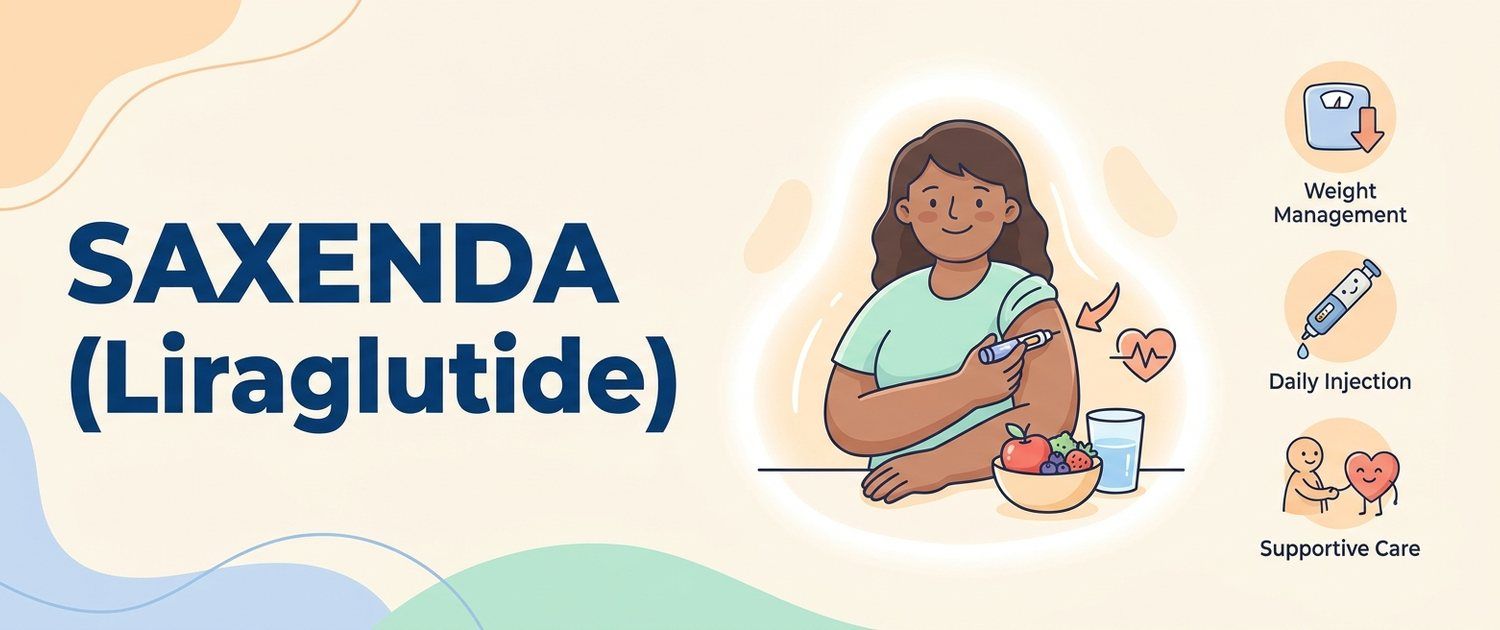
Liraglutide is the oldest member of the GLP-1 receptor agonist class used for weight management, and this story began with it. It gets less attention today than semaglutide and tirzepatide, but it has not gone anywhere, and it has its own characteristics.
How it works
The mechanism is shared across the class: the drug mimics GLP-1, a hormone released in the gut after eating. Several effects follow — enhanced insulin secretion in response to food, slower gastric emptying, and action on satiety centres in the brain. What people experience is earlier fullness and reduced interest in food.
What distinguishes liraglutide from the newer drugs is duration of action. Its half-life allows once-daily dosing, whereas semaglutide and tirzepatide are designed for weekly injection. In practice that means seven injections a week rather than one.
How much weight it reduces
In clinical trials, liraglutide at weight-management doses produced an average of around 8% of body weight. For comparison: semaglutide around 15%, tirzepatide roughly 20–22%.
That difference is substantial, and it explains why attention shifted to the newer drugs. As everywhere in this class, a wide spread sits behind the average: what to expect and why responses differ is covered in the article on real-world results.
How it compares
Briefly. Dosing frequency: liraglutide daily, semaglutide and tirzepatide weekly. Efficacy: liraglutide is lower than both. Mechanism: liraglutide and semaglutide act on one receptor (GLP-1), tirzepatide on two (GLP-1 and GIP), which is linked to its stronger effect. Tolerability: a similar profile, predominantly gastrointestinal.
It does not follow that newer is always better for you specifically: availability, cost, coexisting conditions and individual tolerability all matter. The choice is made by a doctor.
Side effects
The profile matches the class: nausea, fullness, constipation or diarrhoea, belching — more often at the start and after dose increases. Separately there are effects caused not by the drug but by rapid weight loss: gallstones, muscle loss, hair shedding, nutrient deficiencies. All of this is covered in the article on side effects.
The signs requiring immediate care are the same across the class: severe belt-like abdominal pain with vomiting, intense right upper abdominal pain, repeated vomiting with dehydration.
Who it does not suit
Contraindications across the class largely overlap and include, in particular, a personal or family history of medullary thyroid carcinoma and multiple endocrine neoplasia type 2, with a history of pancreatitis as a caution. The full picture is in the article on contraindications.
Suitability is always assessed by a doctor, who also decides whether any tests are needed beforehand.
What to monitor
The sensible set matches the class: glucose and insulin with HOMA-IR calculated, HbA1c, a lipid panel, liver enzymes. With noticeable weight loss, add ferritin, B12 and vitamin D.
If you already have results, a read of your labs will show what the weight loss explains and what needs separate attention.
For informational purposes only
This article is for informational purposes only and does not constitute medical advice, diagnosis, or treatment. Please consult a healthcare professional for medical guidance.