Thyroid Ultrasound: What It Shows, Normal Values and Results
Reviewed by the LabReadAI medical team
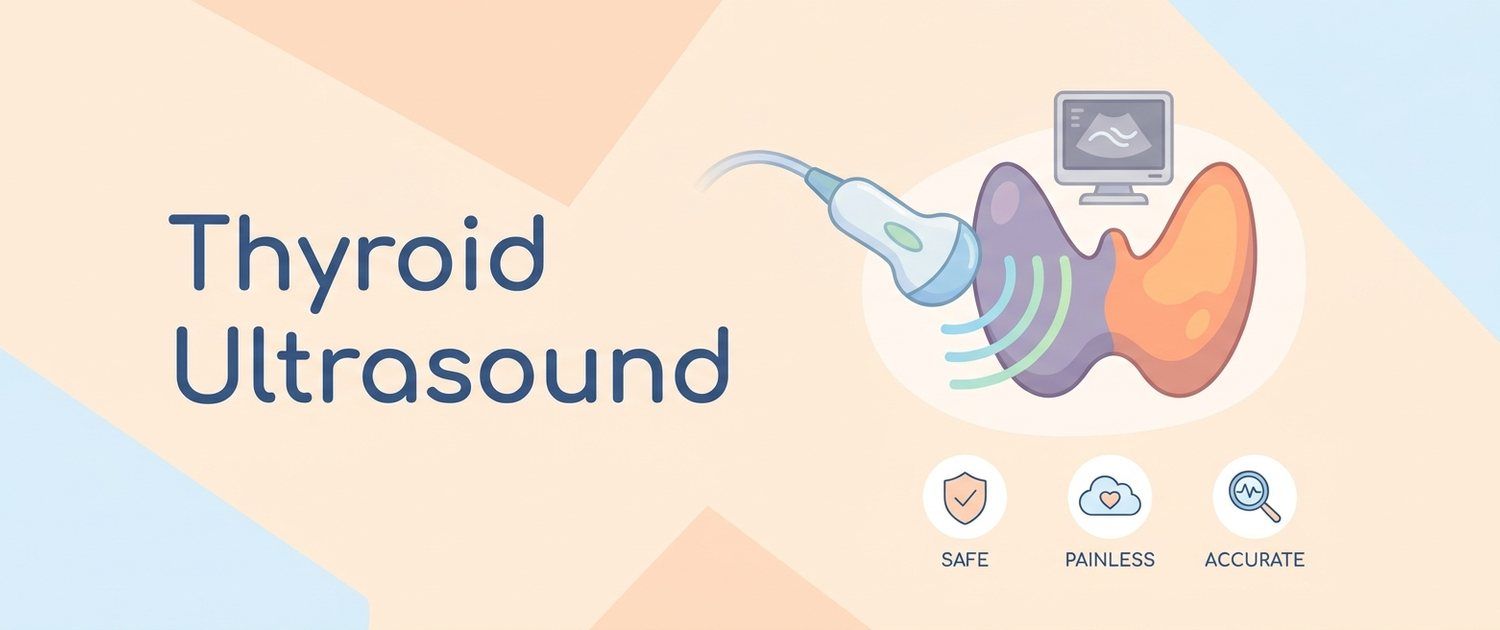
A thyroid ultrasound is a fast, safe way to assess the gland that runs your metabolism. But the report shows "volume", "echogenicity", "TI-RADS 3 nodule", "diffuse changes" — with no sense of whether that is dangerous. Let's break down what a thyroid ultrasound shows, which values are normal and how to read the result together with hormones.
What a Thyroid Ultrasound Shows
Ultrasound assesses the structure of the gland: its size and volume, tissue echogenicity (density), homogeneity, blood flow and — most importantly — nodules. Ultrasound answers "what the gland looks like" well, but not how it works: hormone levels are assessed only by blood tests (TSH, free T4). So ultrasound and hormones are always interpreted together.
Thyroid Ultrasound Norms: Volume and Structure
The main size metric is the combined volume of both lobes:
| Group | Normal thyroid volume |
|---|---|
| Women | up to 18 mL |
| Men | up to 25 mL |
| Children | by age-based nomograms |
Normally the gland has a homogeneous structure, medium echogenicity and smooth contours. An enlarged volume is a goitre (can occur with iodine deficiency); a reduced volume reflects atrophy after long-standing inflammation.
Thyroid Nodules and the TI-RADS Scale
Nodules are a very common finding, and most are benign. To standardise risk, the TI-RADS scale is used: the doctor scores the nodule's features (composition, echogenicity, shape, margins, inclusions) and assigns a category:
- TI-RADS 1–2 — normal / benign, monitoring;
- TI-RADS 3 — probably benign, size follow-up;
- TI-RADS 4 — suspicious, biopsy may be needed;
- TI-RADS 5 — high risk, biopsy required.
The TI-RADS category and nodule size together decide whether a biopsy is needed. A hypoechoic (dark) nodule with irregular margins and microcalcifications is more concerning than a homogeneous isoechoic one.
Echogenicity and Diffuse Changes
"Reduced echogenicity" and "diffuse heterogeneity" of the whole gland is a common pattern of autoimmune inflammation. This can be autoimmune thyroiditis (Hashimoto's): the gland looks "mottled" on ultrasound, and anti-TPO antibodies are raised in the blood. Diffuse changes alone are not a diagnosis but a description, interpreted with hormones and antibodies.
When a Nodule Needs a Biopsy
Fine-needle aspiration (FNA) is not needed for everyone. It is usually recommended for:
- TI-RADS 4–5 nodules;
- TI-RADS 3 nodules above a certain size;
- rapid growth or new suspicious features;
- raised calcitonin (calcitonin — a marker of medullary cancer).
Most biopsies return a benign result. Suspicion of thyroid cancer arises only for a small share of nodules — but that is exactly why suspicious nodules are not ignored.
Ultrasound and Hormones: Why They Are Read Together
Ultrasound shows the picture, hormones show function. Their combinations:
- normal ultrasound + elevated TSH → possible subclinical hypothyroidism;
- "mottled" gland + high anti-TPO → autoimmune thyroiditis;
- nodule + low TSH → possible "hot" (autonomous) nodule with hyperthyroidism.
So the baseline set is ultrasound plus a thyroid panel.
Common Conclusions and What They Mean
| Phrasing | What it usually means |
|---|---|
| Volume within normal, homogeneous structure | Normal |
| Diffuse changes, reduced echogenicity | Possible autoimmune thyroiditis — needs anti-TPO |
| TI-RADS 2–3 nodule | Most often benign, monitoring |
| TI-RADS 4–5 nodule | Suspicious — biopsy discussed |
| Enlarged volume (goitre) | Seek the cause: iodine, autoimmune process |
When to See a Doctor and the Limits of the Method
Ultrasound does not make a final diagnosis or assess function. After it, hormones, antibodies, sometimes a biopsy and an endocrinologist are often needed. See a doctor urgently for a rapidly growing nodule, hoarseness, difficulty swallowing or enlarged neck lymph nodes.
You can upload a thyroid ultrasound report or image and get a plain-language breakdown with the imaging and ultrasound interpretation service — it helps you understand what is normal and what to discuss with an endocrinologist. The service does not replace an in-person visit.
This article is for informational purposes. Reading an ultrasound and the diagnosis are the doctor's job.
For informational purposes only
This article is for informational purposes only and does not constitute medical advice, diagnosis, or treatment. Please consult a healthcare professional for medical guidance.