How to treat insulin resistance: food, movement and what a doctor decides
Reviewed by the LabReadAI medical team
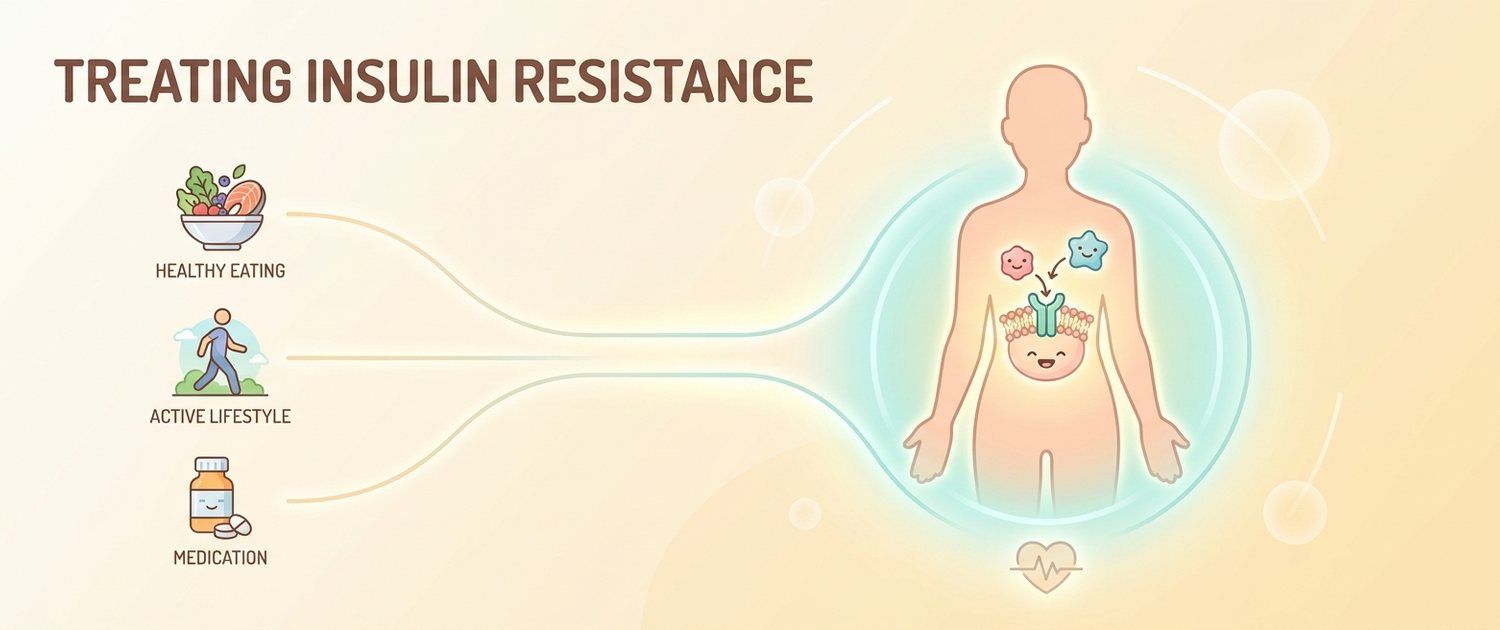
The good news about insulin resistance: in its early stages it is reversible, and it is one of the few conditions where non-drug measures genuinely change the numbers rather than merely being «good for you». The bad news: there are no fast solutions, and most mistakes come from expecting one.
Where treatment starts
With understanding the cause and the scale. Before changing anything you need baseline numbers: fasting glucose and insulin from the same draw with the HOMA-IR index calculated, HbA1c, a lipid panel and liver enzymes.
Something else matters too: making sure no neighbouring condition is dragging the picture along — reduced thyroid function, hormonal causes in women, deficiencies. Working on insulin resistance against untreated hypothyroidism means spinning your wheels.
Weight loss is the main lever
This is the most predictable tool available. Losing even 5–10% of body weight noticeably improves insulin sensitivity, and reducing visceral fat — the fat around internal organs — matters most.
A practical consequence follows: waist circumference is more informative than weight. It reflects the visceral component better, and it often improves while the scale stands still.
Movement: why resistance work matters more than it seems
There is a mechanism here that explains a lot. A working muscle takes glucose from the blood by a route that does not require insulin. In other words, physical activity lowers blood sugar by bypassing precisely the link that is broken.
Then there is mass: the more muscle tissue, the greater the «capacity» for glucose and the higher resting energy expenditure. So resistance training in insulin resistance is not an add-on to cardio but a tool in its own right. Aerobic work helps too, and the combination works best.
Regularity and breaking up long sitting matter separately: short movement breaks through the day affect post-meal glucose independently of workouts.
Food: what actually counts
There is no universal «insulin resistance diet», and no foods with magical properties. Duller things work.
An energy deficit, if there is excess weight — the baseline condition; without it little else moves. Adequate protein — it preserves muscle during weight loss and satisfies better. Fibre and whole foods instead of fast carbohydrates — they smooth post-meal glucose and insulin rises. Cutting sugary drinks — probably the best return per unit of effort.
As for the specific pattern — low-carbohydrate, Mediterranean, time-restricted — studies show comparable results at equal energy deficit. Choose the one you can keep for years, not the one that sounds most impressive.
Sleep and stress are not filler
Insufficient sleep worsens insulin sensitivity measurably and quickly, within days. Chronic stress acts the same way through cortisol. These are the factors people habitually cross out as secondary, and then cannot understand why nothing moves despite decent eating and training.
What a doctor decides
Medication exists, and the decision is individual — based on the full set of labs, age, weight, coexisting conditions and what has already been tried. We deliberately name no drugs or doses here: this is not an area where article advice belongs.
See a doctor — an endocrinologist or GP — with results in hand if HOMA-IR is persistently raised, if HbA1c has entered the prediabetes range, if there are coexisting conditions, or if several months of lifestyle change have moved nothing.
How long before you see results
How you feel — sugar cravings, post-meal sleepiness — changes first, sometimes within weeks. Insulin and HOMA-IR respond more slowly. HbA1c reflects average glucose over 2–3 months, so retesting it sooner is simply pointless.
A sensible horizon for the first check is 3 months. To understand what changed and what did not, a read of your labs over time looks at direction rather than a single point.
For informational purposes only
This article is for informational purposes only and does not constitute medical advice, diagnosis, or treatment. Please consult a healthcare professional for medical guidance.