How to raise ferritin: diet, iron supplements and timelines
Reviewed by the LabReadAI medical team
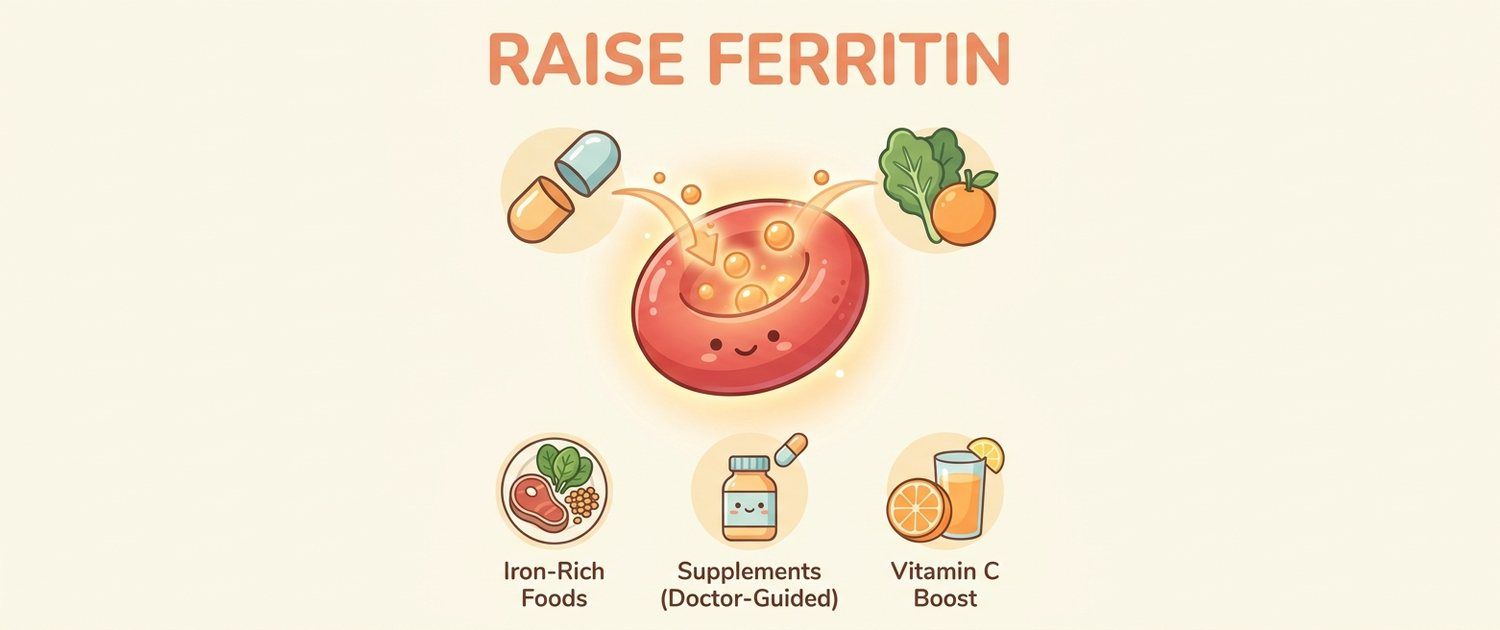
Constant fatigue that a weekend does not fix, hair loss, feeling cold, breathlessness on stairs, trouble concentrating — very often the cause is not stress or age but depleted iron stores. And you can see it long before anaemia shows up in your blood count: you just have to look at ferritin.
What ferritin is, and how it differs from iron
Ferritin is the protein your body stores iron in. The simplest way to picture it: serum iron is the cash in your wallet today, while ferritin is your savings account. The wallet can look fine while the account is empty, which is why serum iron alone says nothing about your reserves.
The body spends that reserve in a strict order. Ferritin goes first. Then iron delivery to tissues suffers. Only last does haemoglobin fall — that is, anaemia develops. Months or years can pass between the onset of deficiency and anaemia, and throughout that time a person feels unwell while their «complete blood count is normal».
Why the reference range can mislead you
Most laboratories set the lower limit around 10–15 ng/mL. That number answers the question «is there anaemia», not «is there enough iron to feel well». So a ferritin of 15 in a woman formally falls within range even though her store is essentially empty.
Clinicians usually work towards markedly higher targets, especially when fatigue or hair loss is the complaint. Your specific target is set by a doctor: it depends on sex, age, pregnancy, other conditions and what the rest of your markers are doing.
Why ferritin falls
The causes fall into three groups, and which one is yours changes everything.
Losses. The most common cause in women is heavy or prolonged periods. In men and post-menopausal women, iron loss almost always means occult gastrointestinal bleeding — and that is the case where the source must be found rather than simply «taking some iron».
Not enough coming in. Restrictive diets, unplanned vegetarian or vegan eating, prolonged undereating, growth spurts and pregnancy, when requirements rise sharply.
Poor absorption. Low stomach acid, coeliac disease, inflammatory bowel disease, Helicobacter pylori infection, or a history of stomach surgery. Here you can eat plenty of iron and still stay deficient.
What to test alongside ferritin
Ferritin on its own is nearly useless, and here is why: it is also an acute-phase protein. Any inflammation, infection, flare of a chronic condition or heavy exercise raises it — so it can look normal while stores are genuinely empty. That is exactly why CRP is measured next to it: if CRP is up, ferritin must be interpreted with that in mind.
A sensible minimum is an iron panel: ferritin, serum iron, TIBC and transferrin with the saturation calculated. To that people usually add a complete blood count with red-cell indices and, when fatigue and hair loss are the complaint, vitamin B12, folate, TSH and vitamin D — deficiencies rarely arrive alone.
Diet: what actually works
Dietary iron comes in two forms, and they are absorbed in fundamentally different ways.
Haem iron — from meat, liver, poultry and fish. Absorbed well, roughly 15–35%, and largely regardless of what you eat with it.
Non-haem iron — from grains, legumes, greens, buckwheat and apples. Absorbed several times worse, around 2–10%, and very sensitive to what shares the plate. The practical conclusion: buckwheat and pomegranates will not close a deficiency on their own, whatever the internet says.
Vitamin C in the same meal noticeably improves non-haem absorption — peppers, greens, citrus, sauerkraut. Tea and coffee (tannins), dairy (calcium) and excess bran and whole grains (phytates) work against it. Hence a simple rule: keep tea and coffee an hour or so away from meals.
An honest caveat: with a pronounced deficiency, diet works as support and as protection against a repeat fall, but food alone usually cannot refill a badly depleted store — the daily amounts involved are simply too small.
Supplements: what matters
A doctor decides on the product, the form, the dose and the duration — here that is not a formality but a necessity: excess iron is toxic, and taking it blindly when there is undiagnosed bleeding simply masks the problem.
What is useful to know in advance. Iron absorbs better on an empty stomach, but that is also when it most often irritates it, so the regimen is chosen individually. There is evidence that alternate-day dosing is better tolerated and absorbs no worse than daily dosing — worth discussing with your doctor if tolerance is poor. Calcium, magnesium and zinc supplements and antacids are not taken at the same time as iron: they compete for absorption.
Dark stools during treatment are an expected effect, not a complication. Marked abdominal pain, vomiting or persistent constipation, on the other hand, are reasons to contact your doctor and adjust the regimen.
How long it takes for ferritin to rise
This is the most common question — and the most common source of disappointment. Wellbeing usually improves before the numbers do: energy returns within the first weeks. Haemoglobin, if it was low, responds over a month or six weeks. Ferritin itself — the actual refilling of the store — rises slowest of all, and that takes months.
The practical conclusion: retesting after two weeks is pointless. A reasonable check is no earlier than 6–8 weeks after starting, and always with CRP, so an inflammatory rise is not mistaken for success. Treatment is almost always continued after the numbers normalise — otherwise the store never fills and everything comes back.
When you need a doctor rather than your own plan
Always — if the deficiency is in a man or a post-menopausal woman; if there is blood in the stool, black stools outside iron treatment, or unexplained weight loss; if ferritin is low and haemoglobin has already fallen; if the level does not rise on treatment. That last case usually means either ongoing loss or malabsorption — and both call for finding the cause, not for switching products.
If you already have results in hand, you can read them alongside the rest of your metabolism: ferritin is almost never the only finding.
For informational purposes only
This article is for informational purposes only and does not constitute medical advice, diagnosis, or treatment. Please consult a healthcare professional for medical guidance.