High Urea (BUN): Normal Levels, Causes and What to Do
Reviewed by the LabReadAI medical team
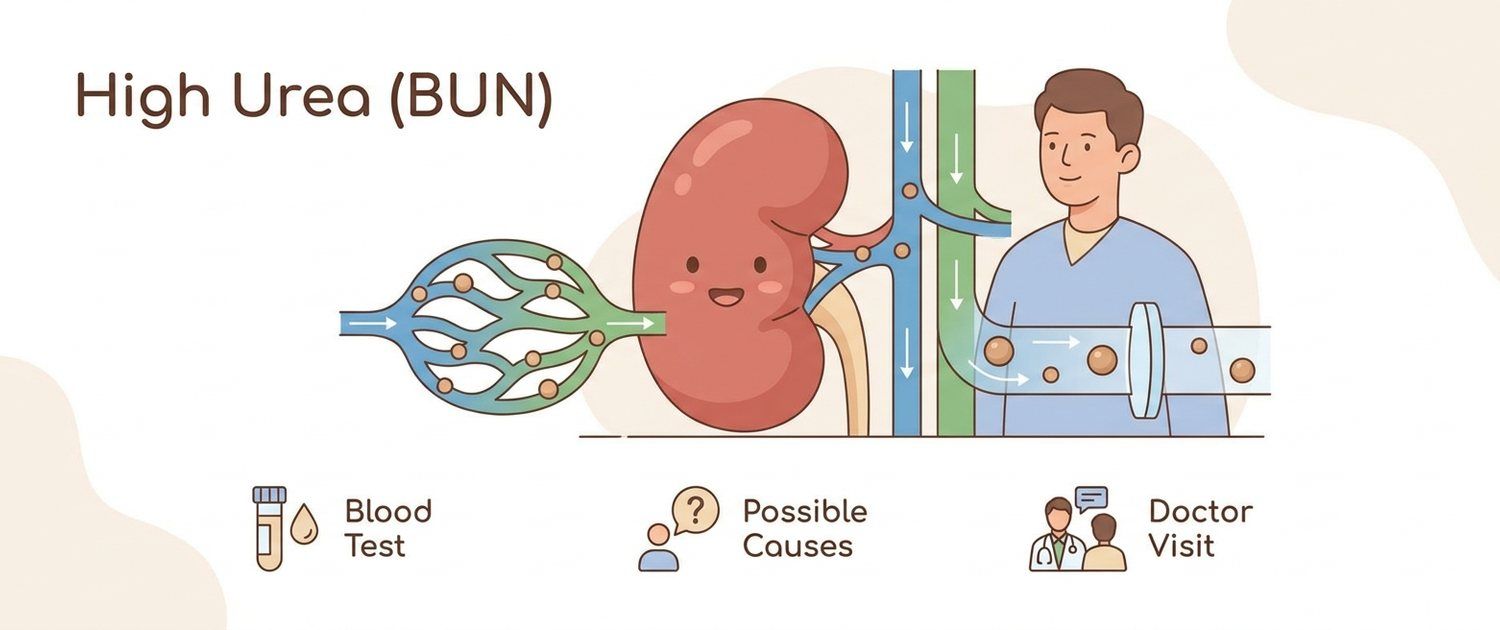
A chemistry panel with high urea flagged usually triggers one thought: kidney failure. Yet this marker climbs with a hot week and too little water, with a protein-heavy diet, with a course of steroids, even with bleeding in the gut — situations where the kidneys have nothing to do with it. Here is what blood urea actually measures, what normal levels look like in adults, older people and children, how it differs from creatinine, and which combinations genuinely need a doctor.
What Urea Is and How the Body Makes It
Blood urea is the end product of nitrogen disposal. When protein from food or from your own tissue breaks down, ammonia is released — a compound toxic to the nervous system. The liver locks it into the urea cycle, turning it into a harmless molecule that the kidneys then excrete.
Two conclusions follow immediately. First, three links in a chain govern the number: how much protein broke down, how well the liver works, and how well the kidneys clear it. Second, the marker is inherently volatile. It responds to a steak dinner, to a day without water, to a course of prednisolone — none of which involve kidney disease.
That is why modern practice judges kidney function primarily by creatinine and estimated glomerular filtration rate. Urea remains the second marker, with one unique strength: it reacts to dehydration and protein catabolism earlier and more visibly than creatinine does. Reports label it urea or BUN (blood urea nitrogen), and the two cannot be compared directly — they are different quantities.
Normal Urea Levels in Adults, Older People and Children
Reference ranges depend on age and widen noticeably in later life, simply because filtration declines physiologically with the years.
| Group | Normal range (mmol/L) |
|---|---|
| Children under 14 | 1.8–6.4 |
| Adults 14–60 | 2.5–6.4 |
| Over 60 | 2.9–7.5 |
| Pregnancy (2nd–3rd trimester) | 1.5–5.3 |
Men average slightly higher than women, reflecting greater muscle mass and a more protein-rich diet. In pregnancy the marker falls physiologically: plasma volume rises, filtration increases, and some nitrogen goes to the fetus. Children sit lower at the bottom of the range for the same reason — rapid growth consumes amino acids for building tissue rather than releasing them.
One caveat about units. If a laboratory prints BUN in mg/dL, multiply by roughly 0.357 to reach urea in mmol/L. Comparing normal levels printed by different labs without checking units is the single most common source of false alarm.
High Urea: Causes That Usually Have Nothing to Do With the Kidneys
Contrary to the common assumption, an isolated rise above normal levels far more often has an explanation outside the kidneys. The causes below are listed roughly in order of how often they turn out to be the answer.
Dehydration is cause number one. When fluid is lost, renal blood flow drops and the tubules reabsorb more water — and urea travels back with it. Heat, vomiting, diarrhea, fever or diuretics are enough to push the value up one and a half to two times with perfectly healthy kidneys. Creatinine shifts far less.
A high-protein diet. Sports nutrition, cutting phases, ketogenic eating, a large meat dinner the night before the test — all increase the nitrogen flowing through the urea cycle. The shift is usually moderate, but enough to cross the upper limit.
Gastrointestinal bleeding. Blood inside the gut is protein, and it gets digested and absorbed. With a bleeding ulcer or esophageal varices the marker jumps while creatinine stays put. Black tarry stools together with a high value are grounds for urgent care, not for repeating the test.
Accelerated breakdown of your own protein. Extensive burns and trauma, prolonged fever, thyrotoxicosis, cancer, a resolving large hematoma, and treatment with corticosteroids or tetracyclines all speed up catabolism and generate more nitrogen.
And only then, the kidneys. Reduced filtration in chronic kidney disease, acute kidney injury, inflammation coded as N11 — chronic pyelonephritis, or obstructed urine flow. Here the marker never rises alone: creatinine climbs with it, and often potassium and phosphate as well.
The BUN-to-Creatinine Ratio: Spotting a Prerenal Cause
It is precisely the divergence between the two markers that makes urea useful rather than redundant. The logic runs like this: when fluid is short, the tubules pull urea back into the blood while barely reabsorbing creatinine. So dehydration raises the ratio, whereas true kidney injury lifts both numbers together and leaves the ratio unchanged.
| Pattern | Urea | Creatinine | Most likely explanation |
|---|---|---|---|
| Ratio sharply increased | markedly high | normal or slightly up | Dehydration, bleeding, catabolism |
| Ratio unchanged | high | high | Kidney damage, reduced filtration |
| Ratio decreased | normal or low | high | High muscle mass or muscle breakdown, liver disease |
Because laboratories report the components in different units, threshold figures vary — the direction of the shift matters more than any exact cut-off. As landmarks: with both values in mmol/L the usual ratio is 40–80, and anything above 80 favours a pre-renal cause; on a report using BUN and creatinine in mg/dL the same band reads as 10–20, with values above 20 pointing pre-renal. How to read the other half of the pair is covered in the article on high creatinine, and the marker itself is described on the creatinine page.
Total Protein and Albumin: Protein Metabolism Beside Urea
Urea shows how much protein broke down. To judge whether there is enough of it in the first place, look at a second pair — total blood protein and albumin.
Total protein combines albumin and globulins. Albumin is made by the liver, holds fluid inside the vessels and carries hormones, drugs and bilirubin. Adult reference ranges run around 64–83 g/L for total protein and 35–52 g/L for albumin.
The combinations read as follows. High urea with high total protein and high albumin almost always means hemoconcentration — that is, dehydration, since everything concentrates at once. High urea with low albumin tells a different story: protein stores are low yet breakdown is fast, as happens in severe illness, wasting, burns or renal protein loss. That is exactly where checking protein in urine is worthwhile. Low urea alongside low albumin points at the liver: when the urea cycle falters, both values drop together.
All four markers belong to a standard chemistry panel — what else it contains is covered in the overview of blood biochemistry.
Low Urea: Pregnancy, Diet and the Liver
Values below the reference range alarm people less often than high ones, and usually rightly so — but not always. The causes split neatly into harmless and serious.
Physiological decline occurs in pregnancy and in children during growth spurts. Dietary causes include vegetarian or simply low-protein eating and prescribed protein restriction. Excess fluid intake and intravenous infusions dilute the blood and lower the figure too.
The genuinely worrying scenario is hepatic. When large numbers of liver cells are damaged, the urea cycle stalls: ammonia is not detoxified and the value falls. This pattern in liver cirrhosis or severe hepatitis is not reassuring but a sign of liver failure, particularly when albumin is low and bilirubin is high alongside it.
When eGFR and a Urine Test Are Needed
A single chemistry line does not describe kidney function. The standard minimum looks like this.
Glomerular filtration rate is calculated from creatinine with adjustment for age and sex, using the CKD-EPI equation. That is the real measure of kidney work: an eGFR below 60 mL/min/1.73 m² persisting for three months or longer defines chronic kidney disease, even when the person feels fine. Added to the calculation are a urinalysis and the albumin-to-creatinine ratio in a spot sample, because protein appears in urine before filtration changes. What exactly is read on a urine report is described in the guide to urinalysis.
The full kidney set — creatinine, eGFR, urea, electrolytes and urine — is assembled in the kidney function test panel. When the picture stays unclear, a doctor adds renal ultrasound and 24-hour protein measurement.
Red Flags: Urea and Creatinine Rising Together
Do not delay medical review if any of these apply:
- Urea and creatinine are both high and still climbing on a repeat test.
- Urine output has dropped sharply or stopped altogether.
- Facial puffiness in the morning, ankle swelling by evening, rapid weight gain from fluid.
- High urea together with black stools, vomiting blood or marked weakness.
- Nausea, itching, a metallic taste or confusion alongside high figures.
- The value rose after starting a new medicine, or during dehydration you cannot correct.
A scheduled consultation is warranted when the elevation persists across two consecutive tests, when it appears in someone with hypertension or diabetes, or when potassium, calcium or phosphate are abnormal beside it.
What to Do If Your Urea Is High
First, assess the context rather than the number. Recall how much you drank the previous day, whether there was a heavy meat dinner, a heatwave, a hard workout, diarrhea or a steroid course. Second, repeat the test under calm conditions — fasting, normally hydrated, without a protein load the night before. An isolated moderate elevation with normal creatinine very often settles by itself.
Third, never read the line alone. The minimum companion set is creatinine with eGFR, urinalysis, total protein, albumin and electrolytes. People with high blood pressure or diabetes need this monitoring regularly; a general guide to timing and content is in the health checkup article.
What not to do: start a salt-free or protein-free diet on your own, or begin diuretics and herbal "kidney" remedies. Protein restriction in kidney disease is a medical decision with a calculated daily allowance, and cutting protein without cause accelerates muscle loss. If liver markers are abnormal at the same time, it is worth reviewing the liver panel as well.
To understand the whole report rather than one underlined line, upload it for a lab test analysis: the service matches urea against creatinine, protein and urine findings and shows which combinations need a doctor.
This article is for informational purposes only. Interpreting test results and prescribing treatment is exclusively the responsibility of a physician.
For informational purposes only
This article is for informational purposes only and does not constitute medical advice, diagnosis, or treatment. Please consult a healthcare professional for medical guidance.