High Eosinophil Count: Causes, Normal Range and Red Flags
Reviewed by the LabReadAI medical team
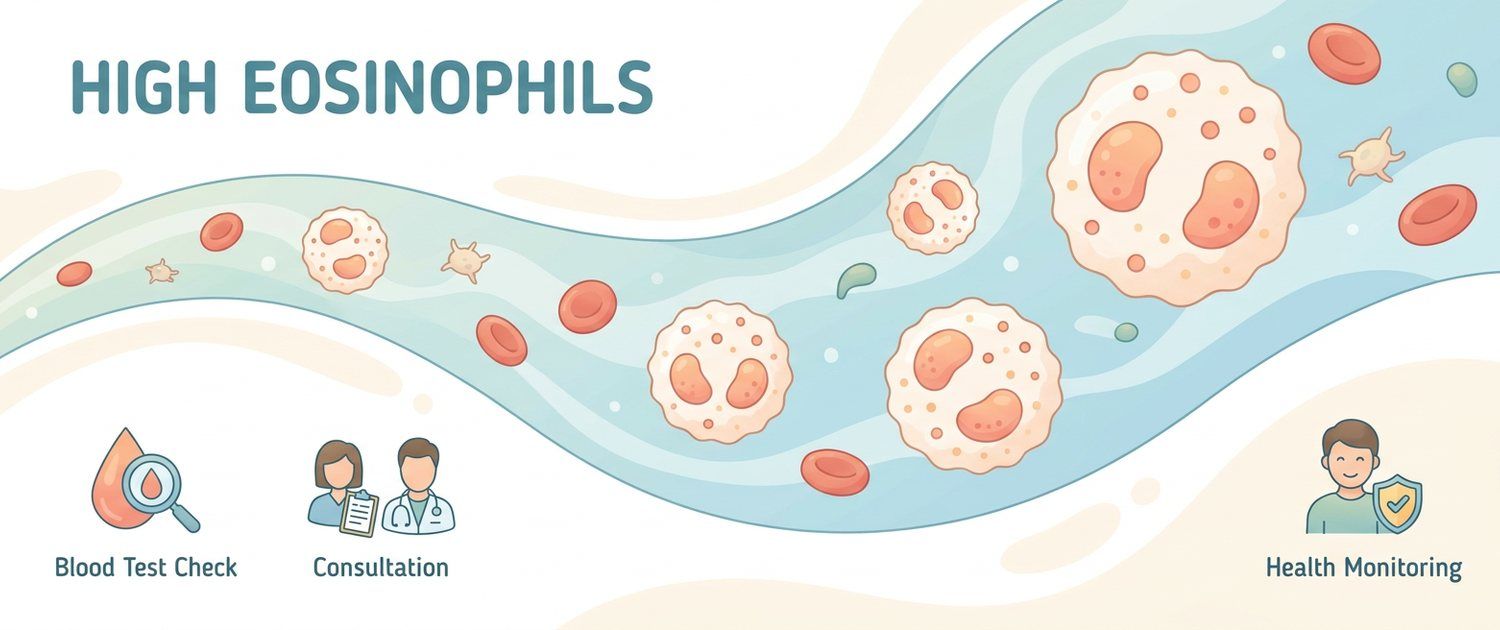
Eosinophils are the white cell fraction that deals with parasites and drives allergic inflammation. Few of them circulate at rest, because they live in tissue rather than in blood: in the gut lining, the airways, the skin. Blood is a road for them, not a home. That is why even a modest rise on a report means something is happening in tissue, and the question is always the same — where.
Normal eosinophil range and what counts as high
A report gives eosinophils on two lines: the percentage (EO%) and the absolute count (EO#).
| Report line | Adult reference |
|---|---|
| EO%, share of white cells | 0.5–5% |
| EO#, absolute count | up to 0.5×10⁹/L |
A value above 0.5×10⁹/L is called eosinophilia. The grades matter, because they set how urgently a doctor is needed:
- mild — 0.5–1.5×10⁹/L: usually allergy, atopy or a drug reaction;
- moderate — 1.5–5.0×10⁹/L: the list narrows, with parasites and drugs moving to the front;
- severe eosinophilia — above 5.0×10⁹/L: a doctor's job, and quickly.
The term hypereosinophilia sits apart: under the WHO and ICC 2024 criteria it means a count persistently above 1.5×10⁹/L, confirmed at least twice at least a month apart. It is a matter of persistence, not of one high figure on a single report.
Eosinophils are never read apart from the rest of the differential — the whole panel is walked through in CBC with differential.
Absolute eosinophil count matters more than the percentage
The percentage is a share of total white cells, not a value in its own right. When white cells are low, the eosinophil share rises on its own although no extra cells appeared. The reverse also happens: in leukocytosis the percentage can stay low while the absolute count has already crossed the line.
A plain example from real reports: white cells 3.4×10⁹/L with 8% eosinophils gives 0.27×10⁹/L, which is normal. White cells 14.0×10⁹/L with 4% eosinophils gives 0.56×10⁹/L, which is eosinophilia. The percentages mislead here; the absolute numbers do not.
If the report omits the absolute count, multiply the percentage by the white cell count and divide by one hundred. Most laboratories print it alongside the other fractions — high neutrophils and high basophils. Eosinophils come as part of a standard complete blood count with differential and are not ordered on their own.
Causes of eosinophilia: allergy, parasites, drugs
In an adult in a temperate country the ranking looks like this:
- Allergy and atopy — the commonest reason for a mild rise.
- Parasitic infection — the first thought in moderate and marked eosinophilia.
- Drug reaction — underrated, and often without a rash.
- Skin disease — eczema, psoriasis, bullous disorders, scabies.
- Less often — eosinophilic oesophagitis and gastroenteritis, eosinophilic pneumonia, systemic vasculitis, autoimmune disease, adrenal insufficiency.
- Rare but serious — hypereosinophilic syndromes, lymphoma, myeloid neoplasms with gene rearrangements.
Those last two are the reason a persistent rise is not left alone: the mechanism differs, and the cells damage tissue by themselves.
Eosinophils and allergy: atopy, asthma, dermatitis
In allergy eosinophils rarely climb above 1.5×10⁹/L. The typical picture is 0.5–1.0×10⁹/L during a season, a flare or contact with a trigger. Total immunoglobulin E is usually read alongside: a high level strengthens the allergic case, but a normal one does not close it, since food and drug allergy often run with normal IgE.
Practical patterns that usually hold:
- a spring rise with sneezing and watery eyes — seasonal pollen allergy, worked through in birch allergy;
- lifelong itch and dry skin — atopic dermatitis, coded L20 in ICD-10;
- reactions to specific foods, especially with lip and tongue swelling — food allergy;
- night-time cough and wheeze — a reason to discuss asthma, where the eosinophil level also guides treatment choice.
The overall logic of an allergy workup is gathered in the allergy guide.
Eosinophils and parasites: worms come first
The rule is simple: the higher the eosinophils, the more seriously parasites must be considered. The detail people miss is that tissue-invasive worms drive eosinophilia, not every parasite. Ascaris, toxocara, liver flukes, strongyloides, trichinella, schistosoma — yes. Pinworms, giardia and most gut protozoa usually run with normal eosinophils.
Two mistakes follow. The first is treating a normal result as proof that worms are absent. The second is testing stool only when eosinophils are high and stopping there: with tissue parasites the eggs appear in stool late or never, and the diagnosis rests on blood antibodies. What to order and in what sequence is set out in helminthiasis; preparation for the stool parasite exam is described separately, and serology for the commonest local infections in opisthorchiasis and toxocariasis.
Travel is its own question. Eosinophilia after the tropics rewrites the list of suspects entirely, and it should be mentioned before any test is ordered.
Drug reactions and skin disease
Almost any drug class can raise eosinophils: antibiotics, anticonvulsants, non-steroidal anti-inflammatories, allopurinol, proton pump inhibitors. The rise is often silent and found by chance on a routine report.
What should alarm is the combination clinicians call DRESS: rash, fever, enlarged lymph nodes, high eosinophils and rising liver enzymes two to eight weeks after a new drug was started. It is a severe condition and needs immediate assessment: the reaction keeps unfolding even after the drug is stopped, so stopping it alone does not close the episode.
Among skin conditions, eczema, bullous pemphigoid, scabies and extensive psoriasis produce a steady rise. Here the skin explains the count and no hunt through other systems is needed — provided the skin diagnosis has actually been made.
Eosinophils in children: higher normal values
In children the upper limit is wider and the swings are larger. Values of 5–7% are routine in infants and preschoolers and mean nothing on their own; as in adults, the absolute count decides.
Three common paediatric causes: atopic dermatitis, food allergy and parasites. A child's eosinophilia is more often transient — it rose during a flare and settled. A repeat in three to four weeks therefore yields more than a broad workup on day one. A full age-adjusted read of a child's report is what the children's lab report review does.
Red flags: when high eosinophils damage organs
One number is worth memorising. A persistent absolute count above 1.5×10⁹/L lasting more than a month needs a doctor regardless of how well the person feels. Not because a tumour always sits behind it. Because the eosinophils themselves release tissue-damaging proteins when they stay high: endocardial fibrosis and valve damage, lung infiltrates, neuropathy, thrombosis. The organ suffers before the symptoms arrive.
Red flags that should not wait:
- breathlessness, swelling or palpitations with high eosinophils;
- numbness, weakness or burning pain in hands and feet;
- fever, night sweats, weight loss, enlarged lymph nodes;
- other lines shifting at once — anaemia, altered platelets, immature forms in the differential;
- rash with fever two to eight weeks into a new drug.
What to do when eosinophils are raised
An order of steps that saves time and money:
- Repeat in three to four weeks, away from a flare and away from antihistamines — with a mild rise and no symptoms this often closes the question.
- Convert to an absolute count if the report shows only a percentage.
- List every drug and supplement taken in the past two months, over-the-counter included.
- Answer three questions: is there a known allergy and to what; was there travel or contact with soil, raw fish or uninspected meat; are there skin or bowel complaints.
- Take that to a physician or an allergist. What follows depends on the level: a mild rise means an allergy workup, a moderate or marked one means parasites and drugs first, everything else after.
If the report is already in hand and every line needs to make sense before the appointment, that is what the lab report review does — reading eosinophils together with the rest of the differential rather than as one isolated figure.
This article is informational. Diagnosis and treatment decisions belong to a doctor.
For informational purposes only
This article is for informational purposes only and does not constitute medical advice, diagnosis, or treatment. Please consult a healthcare professional for medical guidance.