High and Low Neutrophils: Causes, Norms and Left Shift
Reviewed by the LabReadAI medical team
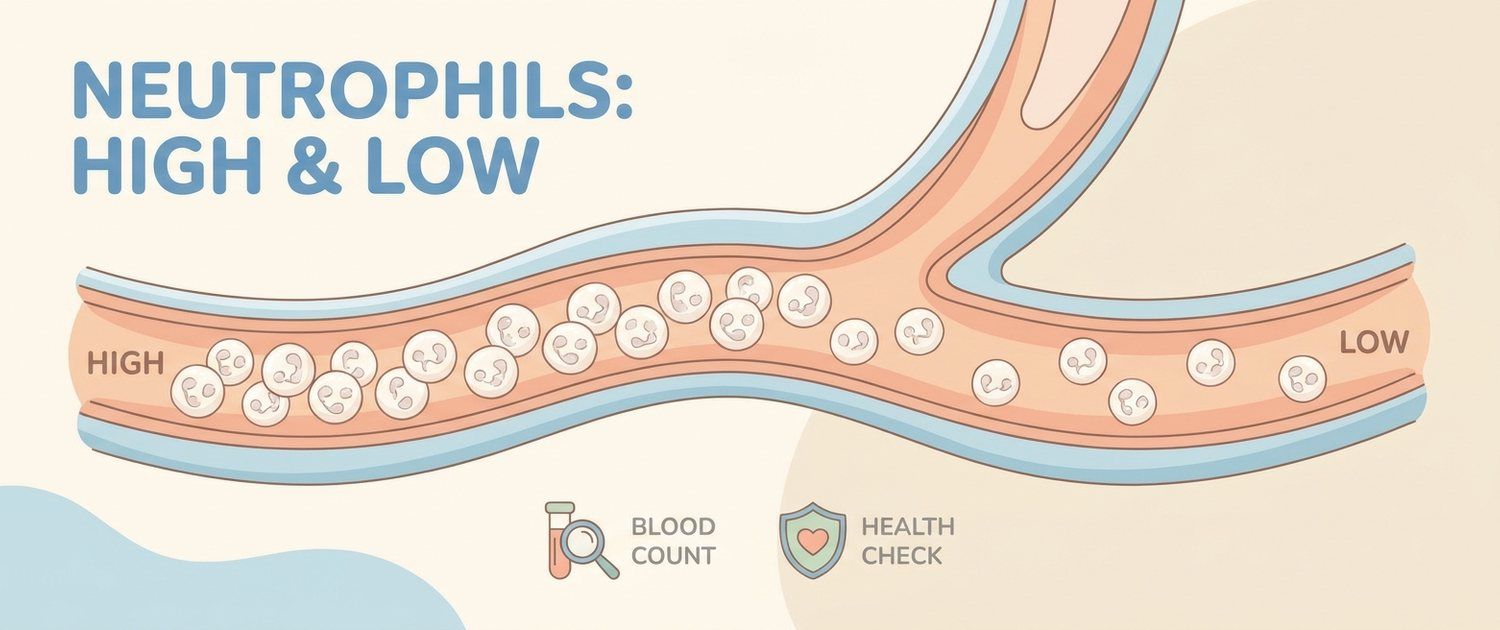
Neutrophils are the most numerous line of the white cell differential and the fastest part of the immune system: they reach an infected site within tens of minutes, engulf bacteria and die with them, forming pus. Their number therefore reacts to almost everything, from tonsillitis to a run taken before the blood draw. The general approach to the form is covered in the blood test guide.
Normal neutrophil counts in adults and children
Most forms split neutrophils into segmented and band cells; some report a single NEUT line.
| Age | Segmented, % | Bands, % | Absolute, ×10⁹/L |
|---|---|---|---|
| Newborns | 47–70 | 3–12 | 6.0–26.0 |
| 1 month — 1 year | 15–45 | 1–5 | 1.5–8.5 |
| 1–4 years | 25–55 | 1–5 | 1.5–8.5 |
| 4–6 years | 35–65 | 1–5 | 1.5–8.0 |
| 6–12 years | 40–60 | 1–5 | 1.8–8.0 |
| 12–18 years | 40–65 | 1–5 | 1.8–7.5 |
| Adults | 47–72 | 1–6 | 1.8–7.5 |
In children the norms shift twice: until 4–5 years neutrophils sit below lymphocytes, so a "low" percentage at that age is expected. Age-specific ranges for every line are applied in a child blood test review. The full reference for the marker is the neutrophils card.
In pregnancy total white cells and neutrophils rise physiologically, especially in the third trimester and during labour; those normal shifts are set out in CBC in pregnancy.
Absolute neutrophil count: the number that matters most
The absolute neutrophil count (ANC) is the only figure from this line used to judge infection risk. It is simple to derive: white cells × (segmented % + band %) ÷ 100.
| ANC, ×10⁹/L | How it reads |
|---|---|
| above 7.5 | neutrophilia |
| 1.8–7.5 | normal adult range |
| 1.0–1.5 | mild neutropenia |
| 0.5–1.0 | moderate neutropenia |
| below 0.5 | severe neutropenia, high infection risk |
Between 1.5 and 1.8 ×10⁹/L lies a borderline zone: the laboratory will flag such a value as low, yet neutropenia proper starts below 1.5.
A percentage without the absolute number misleads in both directions: in a viral infection the neutrophil share drops to 30–35% simply because lymphocytes rose, while the neutrophils themselves stay normal.
Reading the white blood cell differential and the left shift
The white blood cell differential is the distribution of white cells by type, and it is read as a whole rather than line by line: neutrophil dominance points to a bacterial process, lymphocyte dominance to a viral one, rising monocytes to a prolonged or recovering one, rising eosinophils to allergy and parasites, and rising basophils to a rare finding that needs separate work-up. The line-by-line walkthrough is in CBC with differential, and the differential itself belongs to the white cell block.
A left shift is a rise in young band neutrophils and, in severe cases, the appearance of even less mature metamyelocytes and myelocytes. The name is historical: older forms printed immature cells on the left. The meaning is simple — the marrow is releasing its reserve without waiting for cells to mature.
A left shift is not a diagnosis in itself. It reflects a strained marrow response and occurs in bacterial infection, severe inflammation, after surgery and with blood loss. A right shift — hypersegmented, over-mature neutrophils — is rarer and points towards vitamin B12 and folate deficiency.
A separate situation is a leukaemoid reaction: very high white cells with a marked left shift during severe infection. It mimics leukaemia but resolves with its cause.
Segmented and band neutrophils: what the difference means
Segmented neutrophils are the mature working cells, with a nucleus of 2–5 lobes. They make up the bulk of neutrophils in a healthy adult.
Band cells are young, with an unsegmented rod-shaped nucleus. Normally they account for 1–6%. An isolated rise in bands to 7–10% in someone who feels well usually reflects a recent infection rather than a current one.
When segmented neutrophils look low while lymphocytes are normal, look at the absolute number first: a fall in the percentage without a fall in ANC carries no clinical weight.
High neutrophils: causes of neutrophilia
- Bacterial infection. The commonest cause: pneumonia, pyelonephritis, abscess, acute tonsillitis (J03), appendicitis. Usually with a rise in C-reactive protein and raised ESR.
- Physiological neutrophilia. Exercise, stress, pain, labour, a heavy meal, smoking. It lasts hours, which is why blood is not drawn straight after training.
- Glucocorticoids. Prednisolone and its relatives raise neutrophils by releasing the marginated pool — an expected effect, not evidence of infection.
- Sterile inflammation and tissue damage. Myocardial infarction, burns, trauma, pancreatitis, vasculitis, rheumatoid arthritis.
- Smoking. Produces a stable moderate neutrophilia lasting years.
- Blood cancers. Chronic myeloid leukaemia and myeloproliferative disease — rare but important causes of a persistently high neutrophil count without infection.
Low neutrophils: causes of neutropenia
- Viral infection. Influenza, parvovirus B19, viral hepatitis, EBV. The commonest and most benign cause; recovery takes 2–6 weeks.
- Drugs. Metamizole, some antibiotics, antithyroid drugs, anticonvulsants, cytotoxics. Drug-induced neutropenia is the first cause to check, simply by rereading the medication list.
- Chemotherapy and radiotherapy. Expected marrow suppression with a predictable time course.
- Benign ethnic neutropenia. In people of African and some Middle Eastern ancestry the normal ANC sits below European reference ranges — a normal variant linked to the ACKR1 (Duffy-null) genotype, not a disease. These individuals do not get more infections and need no treatment.
- Autoimmune neutropenia. Isolated in young children; in adults with lupus and Felty syndrome.
- Deficiencies. Vitamin B12, folate, copper.
- Marrow disease. Aplastic anaemia, myelodysplastic syndrome, leukaemia. Here neutropenia is almost never isolated — other cell lines fall too.
Red flag: neutrophils below 0.5 and febrile neutropenia
This is the one part of the topic measured in hours rather than weeks.
An absolute neutrophil count below 0.5 ×10⁹/L together with a temperature of 38.0 °C or above is febrile neutropenia. It is an emergency: without neutrophils the body cannot contain bacteria, and an infection can become generalised within hours. Care happens the same day, not by appointment.
The situation is typical for patients on chemotherapy, 7–14 days after a cycle. Seek help immediately for:
- a temperature of 38.0 °C or above with known neutropenia;
- chills, confusion, falling blood pressure;
- mouth ulcers, sore throat, pain on passing urine, skin abscesses;
- any infection in someone who recently had chemotherapy.
Separately: an ANC below 0.5 ×10⁹/L without fever still warrants urgent review, though not emergency admission.
What to do with an abnormal neutrophil result
- Find the absolute number, or derive it with the formula above — the percentage cannot be read without it.
- Reread the medication list: drug-induced neutropenia is the most checkable cause.
- Recall the last 2–6 weeks: infection, fever, a workout before the blood draw.
- If you feel well, repeat the count in 2–4 weeks; one reading means very little.
- With an ANC below 0.5 ×10⁹/L, or fever on top of neutropenia, do not wait for a repeat test.
If the form is already in hand and you want every line explained, that is what a lab report review does.
Which tests are ordered alongside
Inflammatory markers usually come first, and where streptococcal infection is suspected, antistreptolysin O. Red cells and platelets are assessed at the same time: a fall across several lines changes the conversation entirely. For persistent unexplained neutropenia a doctor adds a manual blood film, vitamin B12 and folate, antineutrophil antibodies and, if indicated, a marrow examination.
This article is informational. Diagnosis and further testing are decided by a doctor.
For informational purposes only
This article is for informational purposes only and does not constitute medical advice, diagnosis, or treatment. Please consult a healthcare professional for medical guidance.