Folic Acid: What It Does, Normal Levels and How to Take It
Reviewed by the LabReadAI medical team
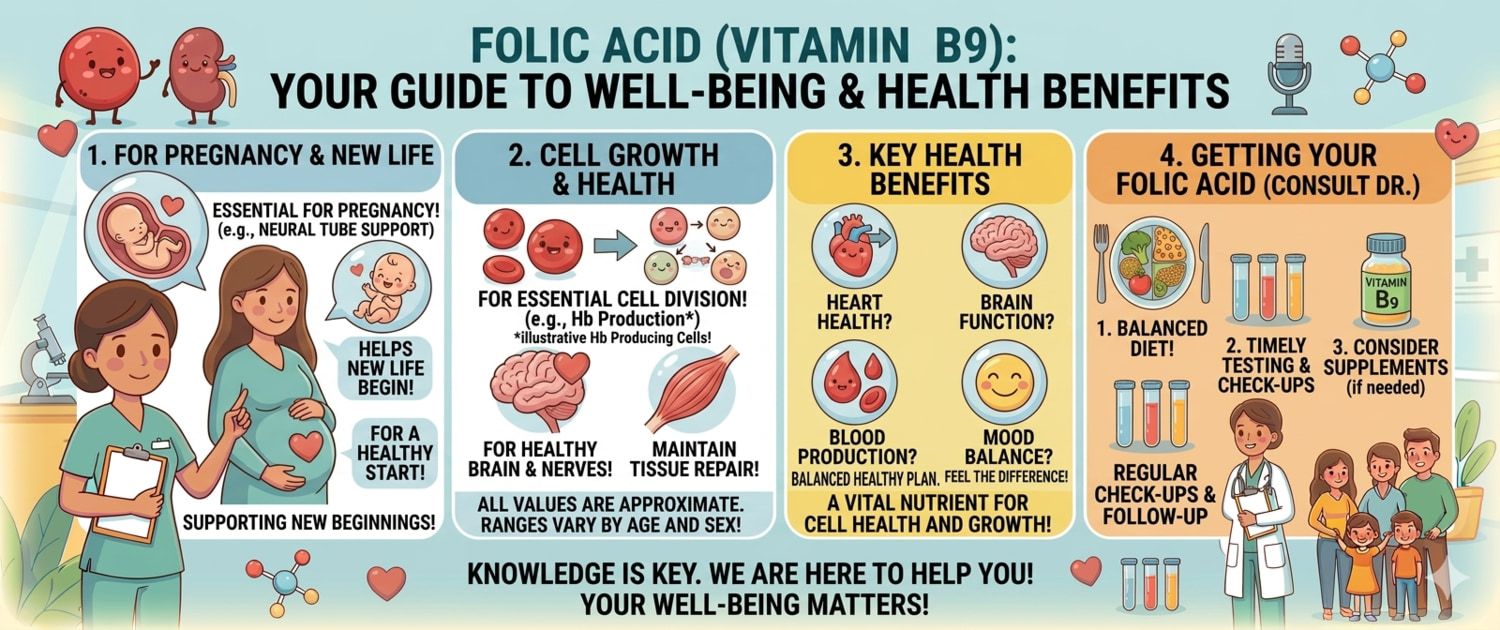
Folic acid is often seen as a "pregnancy vitamin" — taken only during that period. Yet folate deficiency affects 10–15% of adults in developed countries, causes macrocytic anaemia, raises homocysteine, and impairs immune function. Let's look at why folate matters for everyone — not just pregnant women — how folate differs from folic acid, and what MTHFR means.
Folate vs Folic Acid: What Is the Difference
These two terms are often used interchangeably, but they are not the same.
Folate is the general name for a group of naturally occurring vitamin B9 compounds found in food: leafy greens, legumes, liver, avocado. The primary biologically active form inside cells is 5-methyltetrahydrofolate (5-MTHF).
Folic acid is the synthetic form of vitamin B9 used in supplements and fortified foods. It is not active itself: it must undergo several enzymatic conversions in the body before becoming the active form. The key enzyme in this conversion is MTHFR (methylenetetrahydrofolate reductase). Certain MTHFR gene variants reduce this conversion efficiency by 30–70%.
What Folate Does: Key Functions
DNA synthesis and cell division. Folate is a cofactor in nucleotide synthesis (thymidine). Without it, cells cannot divide normally. The most vulnerable are rapidly dividing cells: haematopoietic cells, intestinal epithelium, and embryonic cells.
Methylation. Folate (as 5-MTHF) donates a methyl group to convert homocysteine to methionine. This reaction cannot proceed without vitamin B12 — it is a required cofactor. Folate or B12 deficiency leads to homocysteine accumulation. Hyperhomocysteinaemia is an independent risk factor for atherosclerosis, stroke, and thrombosis.
Neural tube formation. The neural tube — the precursor of the spinal cord and brain — closes on day 21–28 after conception. This happens before most women know they are pregnant. Folate deficiency during this window critically raises the risk of neural tube defects: spina bifida and anencephaly. This is why folate must be taken before conception, not from the first antenatal visit.
Spermatogenesis. In men, folate is involved in sperm DNA synthesis. Deficiency is associated with higher rates of chromosomal abnormalities in sperm.
Normal Folate Blood Levels
| Group | Normal (nmol/L) | Normal (ng/mL) |
|---|---|---|
| Adults | 7–45 nmol/L | 3–20 ng/mL |
| Pregnancy (target) | > 13.5 nmol/L | > 6 ng/mL |
Reference ranges vary between laboratories. Red blood cell (RBC) folate is a more reliable indicator of long-term status than serum folate, which reflects only recent intake.
Symptoms and Signs of Folate Deficiency
Macrocytic anaemia — the main clinical manifestation. Without folate, red cell precursors cannot divide normally: they grow but cannot split, becoming larger than normal. The complete blood count shows elevated MCV above 100 fL and reduced haemoglobin. This picture is identical to B12 deficiency anaemia — which is why both must always be checked together in macrocytosis.
Neurological symptoms — here lies an important distinction from B12 deficiency. With isolated folate deficiency, neurological involvement is usually absent or minimal. With B12 deficiency — subacute spinal cord degeneration, neuropathy, and cognitive impairment occur. This is critically important: giving folic acid when B12 deficiency is unrecognised normalises the anaemia but does not stop neurological progression — masking the problem.
Other symptoms: tongue inflammation (glossitis), mouth ulcers, impaired intestinal epithelial turnover (diarrhoea, malabsorption), depression and cognitive changes with prolonged deficiency, elevated homocysteine.
Causes of Folate Deficiency
Insufficient dietary intake — the most common cause. A diet low in leafy vegetables, legumes, and fresh produce. Alcoholism — folate absorption is impaired with chronic alcohol use.
Impaired absorption — coeliac disease, inflammatory bowel disease, small bowel surgery.
Increased demand — pregnancy, breastfeeding, rapid growth in children, haemolytic anaemias (accelerated red cell turnover).
Drug interactions — methotrexate (blocks dihydrofolate reductase), trimethoprim, carbamazepine, and valproic acid reduce folate absorption or metabolism.
MTHFR polymorphism — a genetic variant reducing conversion efficiency of synthetic folic acid. Not a disease, but a risk factor when intake is borderline.
MTHFR Polymorphism: What to Know
The MTHFR gene encodes the enzyme that converts synthetic folic acid into the active form 5-MTHF. The most common variants are C677T (heterozygote in ~40% of the population, homozygote in ~10%) and A1298C.
In homozygous C677T, enzyme efficiency falls to 30–70%. This does not mean inevitable deficiency — most people with adequate dietary folate compensate for the polymorphism. But with insufficient intake or increased demand (pregnancy), deficiency risk is higher.
Practically important: with MTHFR polymorphism, methylfolate (5-MTHF) is preferred over regular folic acid — it is already the active form and requires no enzymatic conversion. Many modern supplements contain it.
Routine MTHFR testing is not recommended as a general screen — it is indicated for recurrent miscarriage, habitual pregnancy loss, or thrombosis at a young age.
Dosage and How to Take Folic Acid
| Situation | Recommended dose |
|---|---|
| Adults (maintenance) | 400 µg/day |
| Pregnancy planning | 400–800 µg/day (start 3 months before conception) |
| Pregnancy | 400–800 µg/day |
| High risk (MTHFR, previous neural tube defect) | 4–5 mg/day — by prescription only |
| Treatment of deficiency | 1–5 mg/day as a course |
Folic acid can be taken regardless of meals. Toxicity at high doses in healthy people is essentially not described — unlike fat-soluble vitamins.
Folate and Vitamin B12: An Inseparable Pair
This link cannot be ignored. Folate and vitamin B12 operate in the same metabolic pathway. Deficiency of one impairs function of both.
The main risk: giving high-dose folic acid when unrecognised B12 deficiency is present normalises the blood picture (anaemia resolves) but does not stop or slow neurological damage — masking the underlying problem. This is why macrocytosis always requires both markers to be checked before treatment begins.
Hypothyroidism can also impair folate absorption through intestinal involvement — another reason to check TSH when investigating macrocytic anaemia.
Dietary Sources of Folate
Richest in folate: dark leafy greens (spinach, broccoli, romaine lettuce), legumes (lentils, chickpeas, beans), chicken and beef liver, avocado, asparagus, eggs.
Important: folate is destroyed by prolonged heat — boiled spinach contains roughly half the folate of fresh spinach. Fortified grain products (bread, cereals) are a good folic acid source in countries with fortification programmes.
When to See a Doctor
Routine consultation: when planning pregnancy — discuss dosing considering MTHFR status; with macrocytic anaemia — always exclude B12 deficiency before starting treatment; with recurrent miscarriage or thrombosis at a young age.
Summary
Folic acid is not just a "pregnancy vitamin." It is critical for DNA synthesis, immune function, and cardiovascular risk reduction through homocysteine lowering. In pregnancy, supplementation should begin 3 months before conception — the neural tube closes before most women know they are pregnant. When MCV is elevated in a complete blood count, folate and vitamin B12 are always checked together — starting folate blindly is risky.
This article is for informational purposes only. Dosing decisions and deficiency treatment are the responsibility of a physician.
For informational purposes only
This article is for informational purposes only and does not constitute medical advice, diagnosis, or treatment. Please consult a healthcare professional for medical guidance.