Weight Loss After 40: Why It's Harder and What Actually Works
Reviewed by the LabReadAI medical team
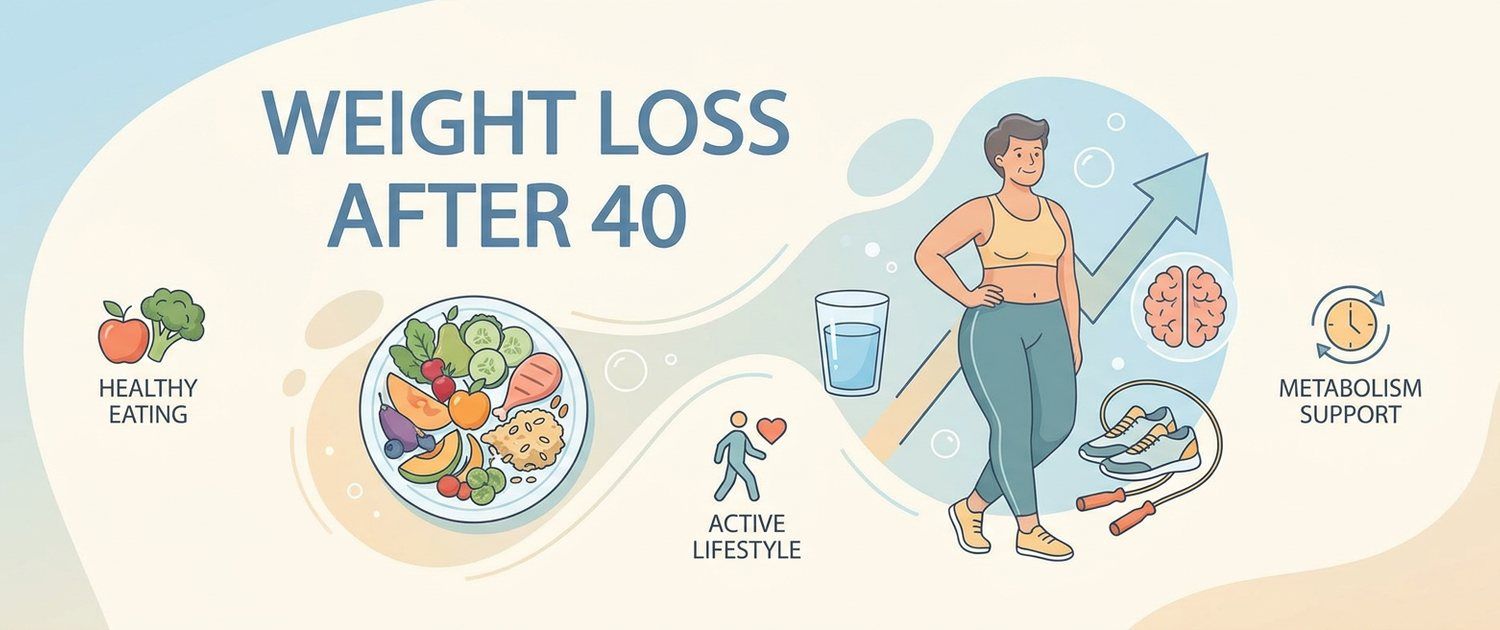
Losing weight after 40 really is harder — but not because your "metabolism broke." A large study of daily energy expenditure showed that expenditure per unit of fat-free mass barely changes between ages 20 and 60: what declines isn't "metabolic rate itself" but the amount of muscle and everyday activity. With age, muscle mass slowly decreases (this is called sarcopenia), and with it drops how much the body burns over a day. What genuinely works after 40 is to preserve and build muscle with strength training, eat enough protein, sleep well, and hold a moderate calorie deficit without starvation extremes. Everything else is packaging.
Below, in order: why weight creeps up with age, what changes in women during perimenopause and in men, the role of the thyroid and insulin resistance, what actually works, and which tests make sense after 40 and after 50.
Why Weight Rises After 40: Sarcopenia and Metabolism
The main culprit is not a "slowed metabolism" but a gradual loss of muscle tissue. After 30–40, a person loses on average a few percent of muscle mass per decade if nothing is done about it. Muscle is the most "expensive" tissue: it burns a noticeable share of energy at rest and is the body's primary consumer of glucose. Less muscle means lower daily expenditure and worse insulin sensitivity.
Basal (resting) metabolism is the energy the body spends at rest on breathing, circulation and organ function. People often say it "falls with age." More precisely: expenditure per kilogram of fat-free mass stays stable until about age 60, and total daily expenditure declines mainly because there is less of that fat-free mass and the person moves less. The age-related fall in resting expenditure is estimated at roughly 1–2% per decade — and almost all of it is explained by loss of muscle and activity, not a mysterious "malfunction."
A vicious cycle forms: less muscle → lower expenditure → easier to gain fat → harder to move → even less muscle. It can only be broken from one place — preserving and building muscle. For more on why weight can stall despite effort, see why weight stops moving, and on fat gain itself, the article on obesity.
| What changes after 40 | What it does to weight |
|---|---|
| Loss of muscle mass (sarcopenia) | Lower daily expenditure, worse insulin sensitivity |
| Reduced everyday activity | Less "background" expenditure without exercise |
| Hormonal shifts (oestrogen, testosterone) | Fat redistributes to the abdomen |
| Worse sleep | Greater appetite, craving for fast carbs |
| Less protein than needed | Muscle doesn't recover; a deficit burns muscle |
Weight Loss for Women After 40: Perimenopause and Menopause
In women, hormonal restructuring is added to the age-related loss of muscle — perimenopause, which usually begins at 40–45 and lasts several years up to menopause. The key shift is falling oestrogen. And the issue is less the number on the scale than where the fat is deposited.
A large long-term study of women in transition (SWAN) showed that over the years around the final menstrual period the rate of fat gain roughly doubles, while muscle mass begins to decline. Total weight may not rise faster than "for age" — but body composition shifts for the worse: more fat, less muscle. Over 6 years of follow-up, the average fat gain was about 3.4 kg and waist circumference grew by roughly 5–6 cm.
Why fat moves to the belly. Falling oestrogen shifts fat deposition from the hips and buttocks (the "pear") to visceral fat around the organs (the "apple"). Visceral fat is metabolically active, worsens insulin sensitivity and raises cardiometabolic risk — which is why the waist grows after 40 even in women whose weight is almost unchanged. What happens in the body during this period and what other symptoms occur — in the article on menopause.
The practical takeaway for women after 40 and after 50: the goal is not to "drop kilos at any cost" but to preserve muscle and reduce specifically visceral fat. The same levers work — protein, strength training, sleep, a moderate deficit; extreme diets are especially harmful in this period because muscle is lost faster against falling oestrogen.
Weight Loss After 50: What Is Added
After 50, the same trends intensify. Most women have already reached menopause by this age, the hormonal background has stabilised at a low oestrogen level, and the "window" of easy visceral fat gain partly closes — but the muscle loss accumulated during perimenopause already affects expenditure. In men, the slow testosterone decline becomes more noticeable by 50.
After 50, what matters is not the speed of weight loss but safety and preserving muscle:
- Keep the calorie deficit moderate (usually gentler than at 30) — sharp restriction speeds up loss of muscle and bone.
- Strength training becomes not "advisable" but mandatory: it is the only way to slow sarcopenia.
- Protein at every meal matters more than in youth: with age, muscle responds worse to amino acids and needs a stronger "signal."
- The role of coexisting conditions grows — thyroid, prediabetes, blood pressure — which are more common after 50 and hold weight on their own.
Weight Loss for Men After 40: Testosterone
In men after 40, testosterone declines slowly and gradually — on average by a fraction of a percent per year. This alone doesn't "switch off" weight loss, but excess visceral fat and falling testosterone reinforce each other: adipose tissue accelerates the conversion of testosterone to oestradiol, while low testosterone promotes fat accumulation and muscle loss. That's another self-sustaining cycle.
An important detail: in men with obesity, low testosterone is often a consequence of excess fat rather than the root cause, and losing weight with strength training often pulls testosterone back up. So it makes sense to start not with hormones but with body composition. More in testosterone after 30 and how to raise testosterone; the marker itself — testosterone.
The Role of the Thyroid and Insulin Resistance After 40
Two "silent" reasons why weight after 40 can stall despite effort are reduced thyroid function and insulin resistance. Both become more common with age, and both can be checked with tests.
The thyroid. Thyroid hormones set the pace of metabolism. In hypothyroidism (a lack of hormones), expenditure falls, and fatigue, cold intolerance, puffiness, a tendency to gain weight and constipation appear. Subclinical hypothyroidism becomes more common with age, especially in women, and easily masquerades as "just tired and put on weight." An honest note: hypothyroidism usually adds a few kilos (largely from fluid retention), not tens — but untreated, it genuinely gets in the way of weight loss. What the condition is — in the article on hypothyroidism; the basic screen is TSH and the thyroid panel.
Insulin resistance. With age and accumulating visceral fat, cells respond worse to insulin, the pancreas makes more of it, and high insulin makes it harder to burn fat and increases cravings for fast carbs. It's a frequent companion of the "apple" shape after 40 and the pre-stage of type 2 diabetes. The good news — insulin resistance is reversible with the same levers (muscle, deficit, limiting fast carbs). In detail — insulin resistance and the HOMA-IR index; the hormone itself — insulin.
What Actually Works After 40: Protein, Strength Training, Sleep, a Deficit
There is no "metabolism boost" or miracle remedy. After 40, the same physiology works as before — but with an emphasis on preserving muscle. Four pillars:
1. Enough protein. Protein preserves muscle in a deficit, satiates better, and requires more energy to digest. With age, muscle responds worse to amino acids, so protein should be spread across meals rather than eaten all at dinner. The amount and sources are worth agreeing with a doctor, especially with kidney disease. On supplements — creatine and protein: how to choose.
2. Strength training. This is the main and only direct lever against sarcopenia. Strength work 2–3 times a week preserves and builds muscle, improves insulin sensitivity independently of weight change, and maintains daily expenditure. Aerobic exercise (walking, cycling, swimming) is good for the heart and overall expenditure, but muscle is built by strength training.
3. Sleep. Sleep loss raises appetite, shifts choices toward fast carbs, and worsens insulin sensitivity. After 40, sleep often deteriorates (including from hormonal shifts and apnoea) — and this hits weight directly. Solid sleep is an underrated weight-loss tool.
4. A moderate deficit without extremes. A calorie deficit is needed, but sharp starvation after 40 is counterproductive: it burns muscle, slows progress, and almost guarantees weight regain with a higher body-fat percentage than at the start. A gentle, sustainable deficit you can hold for months beats any "harsh two-week diet."
| What works | What doesn't work / harms after 40 |
|---|---|
| Enough protein spread through the day | "Boosting metabolism" with fat burners |
| Strength training 2–3 times a week | Cardio only, no strength (muscle is lost) |
| A moderate, sustainable deficit | Harsh starvation, extreme diets |
| Solid sleep | Skimping on sleep for workouts |
| Checking thyroid/insulin when stalled | Blaming everything on "age" without tests |
On the approach of "working with body composition and metabolism, not chasing kilos" — in the article on obesity and on why weight stops moving.
Which Tests to Order for Weight Loss After 40
Tests don't make you lose weight, but they find hidden brakes and make a deficit safe. A reasonable baseline set after 40 (and all the more after 50), worth discussing with a doctor:
- TSH (extended to the thyroid panel, free T4, if needed) — to rule out hypothyroidism as a cause of stalled weight and fatigue.
- Fasting glucose and HbA1c — to assess glucose metabolism and prediabetes.
- Fasting insulin + HOMA-IR — a direct assessment of insulin resistance, common after 40.
- Lipid panel — cholesterol, LDL, HDL, triglycerides; atherogenic dyslipidaemia typically accompanies visceral fat.
- Ferritin — iron stores. Hidden iron deficiency causes fatigue, weakness and lower exercise tolerance, so workouts "don't go"; it's common in women with heavy periods.
- Vitamin D — low levels are linked with fatigue and worse exercise tolerance; deficiency is common after 40. See vitamin D deficiency.
- Testosterone (in men with marked visceral fat gain and low energy) — the testosterone marker itself.
This is a guide, not a prescription: the exact list and interpretation are set by a doctor for your situation.
When to See a Doctor
Weight loss after 40 is in most cases a matter of lifestyle, not disease. But it's worth seeing a doctor (GP or endocrinologist) if:
- Weight rises for no reason on the same diet and activity — possible hypothyroidism or another hormonal disturbance.
- Weight won't move for months despite an honest deficit and strength training — grounds to check the thyroid, insulin, medications.
- There is marked fatigue, cold intolerance, puffiness, hair loss — the typical picture of hypothyroidism.
- The waist grows fast (more than 5 cm in six months) — a sign of visceral fat accumulation and cardiometabolic risk.
- Sudden weight loss without effort, thirst, frequent urination — to rule out diabetes and other causes.
- You plan a harsh diet, weight-loss medications or intense training on top of chronic conditions — such decisions are made only with a doctor.
Weight loss after 40 and after 50 is not a fight against a "broken metabolism" but sensible work with muscle, sleep, nutrition and hormones. Slowly, sustainably, and with a check for hidden brakes — this path beats any miracle promise.
This article is for informational purposes only. Diagnosis, a weight-loss plan and any medications are the responsibility of an endocrinologist or general practitioner.
For informational purposes only
This article is for informational purposes only and does not constitute medical advice, diagnosis, or treatment. Please consult a healthcare professional for medical guidance.