Daily Calorie Intake: How to Calculate TDEE Correctly
Reviewed by the LabReadAI medical team
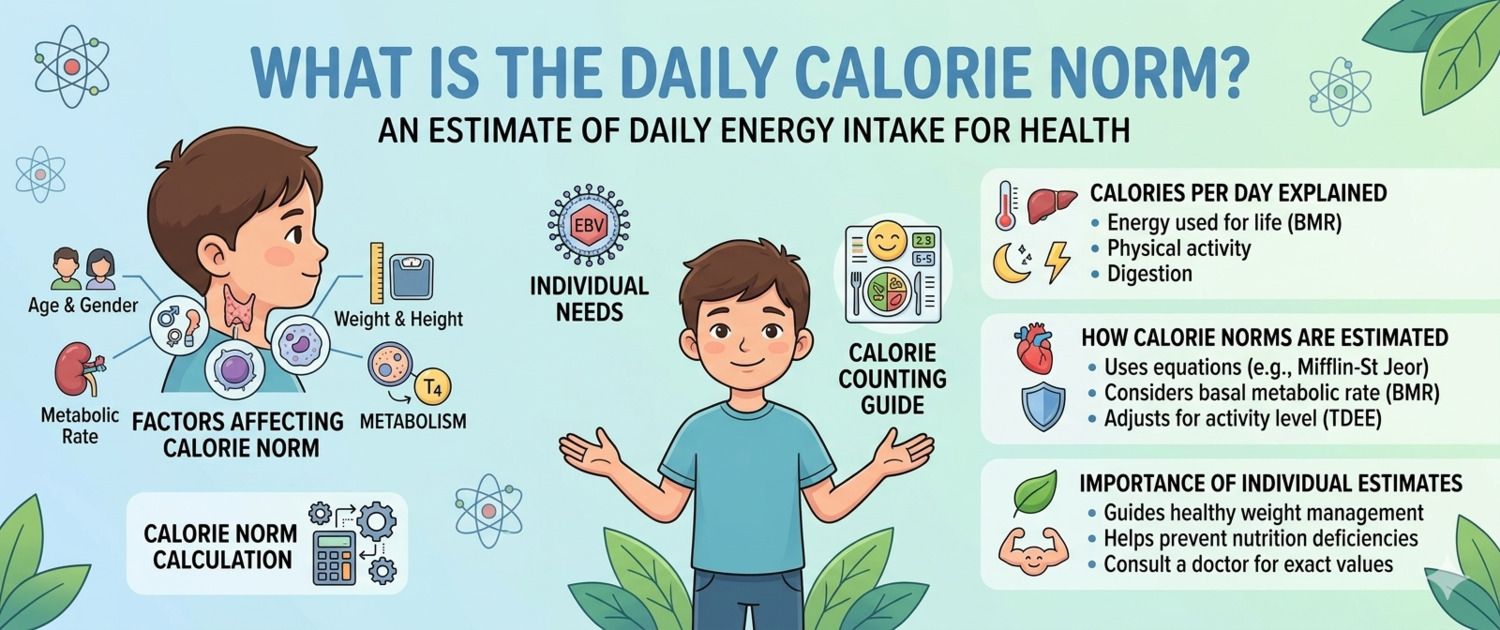
"Eat 2000 calories a day" — advice that is simultaneously correct for some people and completely useless for others. The energy needs of a 25-year-old marathon runner and a 60-year-old woman with a desk job differ by a factor of one and a half to two. Let's look at how to calculate your actual calorie norm, what TDEE and BMR really mean, how to distribute macronutrients, and how nutrition directly affects your blood test results.
BMR and TDEE: The Difference and Why It Matters
Most people confuse two fundamentally different concepts.
BMR (Basal Metabolic Rate) — the number of calories the body burns at complete rest: breathing, heartbeat, temperature maintenance, protein synthesis. This is the energy you would burn lying in bed all day without moving.
TDEE (Total Daily Energy Expenditure) — the actual number of calories you burn accounting for all daily activity: work, exercise, household activity, even the thermic effect of food. TDEE is your actual calorie norm.
Why many people "eat to their norm" and don't lose weight: they confuse BMR with TDEE or overestimate their activity level.
How to Calculate BMR: The Mifflin-St Jeor Formula
The most accurate widely available formula for basal metabolic rate:
For men: BMR = 10 × weight (kg) + 6.25 × height (cm) − 5 × age (years) + 5
For women: BMR = 10 × weight (kg) + 6.25 × height (cm) − 5 × age (years) − 161
Example: a 35-year-old woman, 65 kg, 168 cm. BMR = 10×65 + 6.25×168 − 5×35 − 161 = 650 + 1050 − 175 − 161 = 1364 kcal/day
This is her basal metabolic rate. To get her actual calorie norm, multiply by an activity multiplier.
Activity Multipliers: The Main Trap
| Activity level | Description | Multiplier |
|---|---|---|
| Sedentary | Desk job, no exercise | × 1.2 |
| Light | 1–2 light workouts per week | × 1.375 |
| Moderate | 3–5 workouts per week | × 1.55 |
| Active | 6–7 intense workouts | × 1.725 |
| Very active | Physical labour + daily training | × 1.9 |
The main trap: most people choose a multiplier one level above their actual activity. A person with a desk job and three weekly workouts is "moderate," not "active." Overestimating by one level adds 200–400 extra kcal per day — over a year that is a 7–14 kg difference.
For our example (woman, moderate activity): TDEE = 1364 × 1.55 = 2114 kcal/day — her actual maintenance calorie norm.
Calorie Norms for Different Goals
| Goal | Adjustment | Expected result |
|---|---|---|
| Weight loss (gentle) | TDEE − 300–400 kcal | ~0.3–0.4 kg/week |
| Weight loss (standard) | TDEE − 500 kcal | ~0.5 kg/week |
| Weight loss (aggressive) | TDEE − 750–1000 kcal | ~0.7–1.0 kg/week |
| Weight maintenance | = TDEE | stable weight |
| Muscle gain | TDEE + 200–400 kcal | ~0.2–0.4 kg/week |
The physics of fat loss is simple: 1 kg of fat tissue ≈ 7700 kcal. A 500 kcal/day deficit yields roughly 0.5 kg per week. This is mathematics, not a diet.
Minimum threshold: going below 1200 kcal for women and 1500 kcal for men is not recommended without medical supervision. With prolonged deficit, the body lowers BMR — "adaptive thermogenesis" — and weight loss slows.
Macronutrients: How Much Protein, Fat and Carbohydrate
Calories are not equal. The same energy from protein, fat, and carbohydrate affects body composition, satiety, and health very differently.
Protein: The Most Important Macronutrient
Protein is more satiating than carbohydrates or fat, preserves muscle mass during weight loss, and requires more energy to digest (thermic effect 20–30% vs 5–10% for fat and carbohydrate).
| Goal | Protein norm |
|---|---|
| Sedentary lifestyle | 0.8–1.0 g/kg |
| Moderate activity | 1.2–1.6 g/kg |
| Strength training / weight loss | 1.6–2.2 g/kg |
| Intense sport | 2.0–2.5 g/kg |
Protein deficiency during weight loss is the primary cause of losing muscle instead of fat.
Fat: Essential, But Not All Equal
Minimum fat intake: 0.8–1.0 g/kg. Fats are critical for hormone synthesis — including testosterone and estradiol — absorption of fat-soluble vitamins A, D, E, K, and nervous system function.
Fat quality directly affects the lipid panel: saturated fats (red meat, butter) raise LDL; unsaturated fats (fish, olive oil, nuts) raise HDL and lower triglycerides.
Carbohydrates: Fuel for Brain and Muscle
The remaining calories after protein and fat. Quality matters more than quantity: whole grains, legumes, and vegetables cause a gradual rise in blood glucose; simple sugars and refined products cause a sharp insulin spike.
High intake of simple carbohydrates raises triglycerides and lowers HDL — a direct path to metabolic syndrome. Dietary glycaemic control is the first step in preventing type 2 diabetes.
How Nutrition Affects Blood Test Results
Diet is a powerful modifier of laboratory markers. Changes in eating habits produce results faster than most people expect.
Lipid panel: A Mediterranean diet lowers LDL by 10–15% and raises HDL. Reducing trans fats and saturated fats is the most evidence-based dietary intervention for atherosclerosis.
Glucose and HbA1c: Reducing simple carbohydrates and increasing fibre lowers postprandial glycaemia. In prediabetes, dietary change lowers HbA1c by 0.3–0.5% — comparable to initial metformin doses.
Triglycerides: The most diet-responsive marker — they fall within 2–4 weeks of reducing simple carbohydrates and alcohol. This is exactly why a lipid panel must be drawn strictly fasting.
Micronutrient deficiency: Restrictive diets below 1400–1500 kcal frequently lower ferritin and lead to iron deficiency anaemia. Unplanned veganism depletes vitamin B12, calcium, and zinc.
Practical Principles of Healthy Eating
Nutrition is complex in details but simple in core principles. Following these gives 80% of the result:
Protein at every meal — preserves muscle mass and reduces total calorie intake through satiety.
Minimally processed foods — whole grains instead of white flour, legumes, vegetables, fruit, lean meat, fish. They deliver more fibre and micronutrients at lower calorie density.
Control liquid calories — juices, sweet drinks, alcohol provide no satiety but plenty of calories. A glass of orange juice equals 4 oranges in calories but without the fibre.
Meal timing — 3–4 meals with adequate gaps between them reduces total calorie intake better than eating every 2 hours for most people.
When to See a Specialist
See a doctor or registered dietitian for: unintentional weight loss (> 5% of body weight in 6 months); BMI below 18.5 (underweight); disordered eating patterns; chronic diseases (diabetes, CKD, cancer) — calorie norms differ substantially; no results despite a correctly calculated deficit after 3 months — worth checking TSH and fasting glucose.
Summary
A calorie norm is not a fixed number but a formula: BMR × activity multiplier ± goal adjustment. The Mifflin formula gives a starting point; reality fine-tunes it over 3–4 weeks of observation. Diet quality affects health through measurable laboratory markers — lipid panel, glucose, triglycerides — and this is quantifiable. No diet works as a short-term project: lasting change requires rebuilding habits, not willpower.
This article is for informational purposes only. Before making significant dietary changes — especially with chronic conditions — consult a doctor or registered dietitian.
For informational purposes only
This article is for informational purposes only and does not constitute medical advice, diagnosis, or treatment. Please consult a healthcare professional for medical guidance.